Add as a preferred source on Google
One of the must-haves when it comes to website speed is a content delivery network (CDN).
A CDN takes the load off your web server and speeds up content delivery to all site visitors. As a result, everything from your user experience to search engine potential improves!
An excellent way to start learning about the subject is to activate a WordPress CDN.
In this article, we’ll explain the easiest ways to add a CDN to your WordPress site. But before that, we outline the basic definition of a CDN, why you should be using one, and some extra benefits to expect.
We’ll also share some speed tests so you can better judge just how much of a performance boost you could expect to see on your site.
What Is a WordPress CDN?
CDN is short for Content Delivery Network. These are a network of servers (also known as POPs) located around the globe. They are designed to host and deliver copies of your WordPress site’s static (and sometimes dynamic) content, such as images, CSS, JavaScript, and video streams.
How a CDN Works
First off, you don’t want to get a CDN confused with your WordPress hosting company. These are entirely different services.
A CDN isn’t a replacement for your hosting provider, but rather an additional way to increase the speed of your site. While our hosting here at Kinsta is blazing fast, a CDN can make your site even faster.
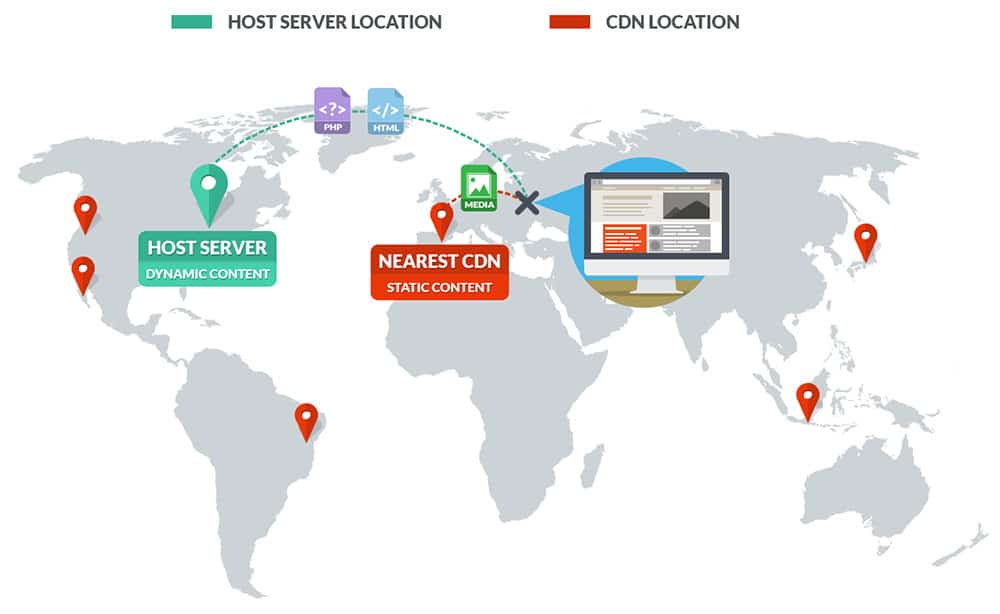
How does a CDN work exactly? For example, when you host your website with Kinsta, you must choose a physical data center location, such as US Central, Europe, South America, or Asia.
Let’s say you choose US Central. This means your website is physically located on a “host server” in Council Bluffs, Iowa. When people in Europe visit your website, it will take longer to load than someone visiting it from, say, Dallas, TX.
Why? Because the data has to travel a further distance.
This is what is known as latency. Latency refers to the time and/or delay involved in data transmission over a network. The further the distance, the greater the latency.
And that is where a CDN comes into play. It helps to reduce that latency by loading your site’s content from servers closer to them. These CDN servers are sometimes called POPs (points of presence).
WordPress users are sometimes reluctant to look into content delivery networks because they sound too complicated. But a CDN’s functionality is relatively straightforward.
Here’s how they work and can be implemented in three simple steps:
- Step 1: You sign up for a hosting provider with a free CDN (like Kinsta CDN) or select a separate CDN provider and subscribe to their service. Third-party CDN providers often offer free and premium plans depending on data usage.
- Step 2: You activate the CDN on your website. For Kinsta CDN, that’s done with the click of a button in the MyKinsta dashboard. You install a free plugin like CDN Enabler or WP Rocket for a third-party CDN to integrate it. These plugins automatically link up your assets to the CDN.
- Step 3: When people visit your website, it loads the content of your WordPress site from different servers around the globe. Visitors in Europe receive your site content from a server in Europe, while visitors in the United States get the same content from a server closer to them in the US.
How Do CDNs Achieve This?
CDNs typically use two technologies to route users to the correct location: IP Anycast + geolocation routing. They can automatically detect where user requests come from and route the requests to the nearest server.
However, choosing a strategic server location for your WordPress host is still vital. Because even though a CDN helps distribute your media and content, a single request still has to be made to the hosting provider when your website is loaded — unless you are utilizing full page caching on a proxy server, which we will go into later.
Kinsta now has 30 data center locations from which you can host your WordPress site.
CDN Benefits
Here are the many benefits of using a CDN on your WordPress site.
1. Performance Boost
A performance increase is one of the biggest reasons to use a CDN.
It has been proven repeatedly that a faster loading site correlates with higher conversion rates, decreased bounce rates, and a longer average visitor duration–not to mention a better user experience all around.
When was the last time you clicked back in your browser because the website took too long to load? This is the last thing site owners want to happen.
But don’t take our word for it. According to Google’s own research, 53% of mobile users abandon a site that takes longer than three seconds to load. And Portent found that a B2B site loading in one second converts at nearly three times the rate of a site loading in five seconds.
These numbers shift slightly across studies, but the direction never does.
Here are a few ways a CDN can help improve the performance of your WordPress site.
Reduces TTFB
We already covered above that a WordPress CDN can help decrease latency by shortening the physical distance required for the data to travel. But it can also help lower your time to first byte (TTFB).
This measures how long the browser waits before receiving its first byte of data from the server. The longer it takes to get that data, the longer it takes to display your page.
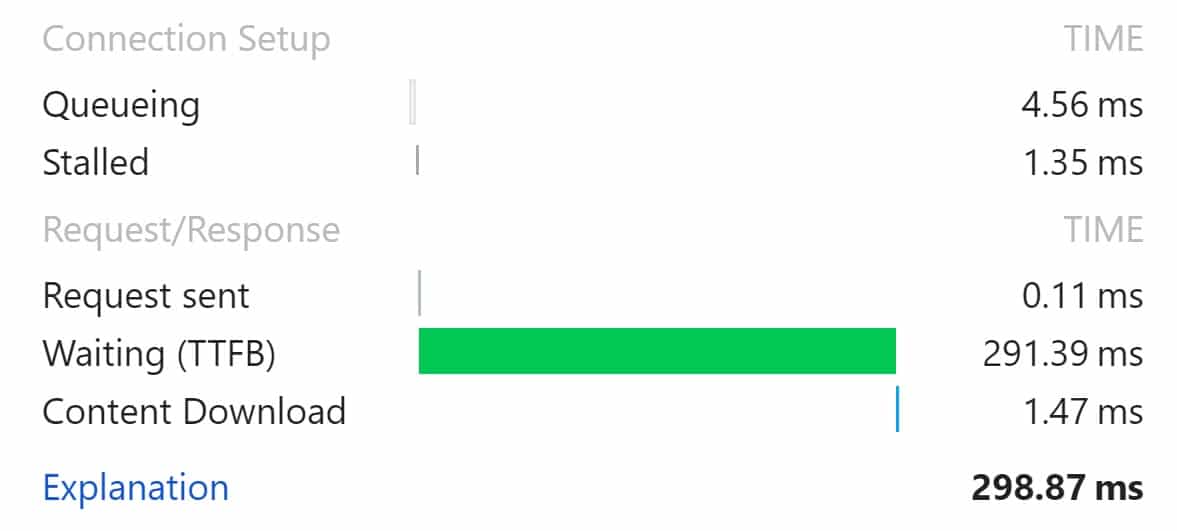
A common misconception is that TTFB is calculated after DNS lookup times. However, the original calculation of TTFB in networking always includes network latency. This involves a 3-step process, so delays and latency can occur anywhere in between, adding to your total TTFB.
High TTFB can be caused by several reasons, such as lousy code or misconfigured caching on your host server. But geographical distance is one concern.
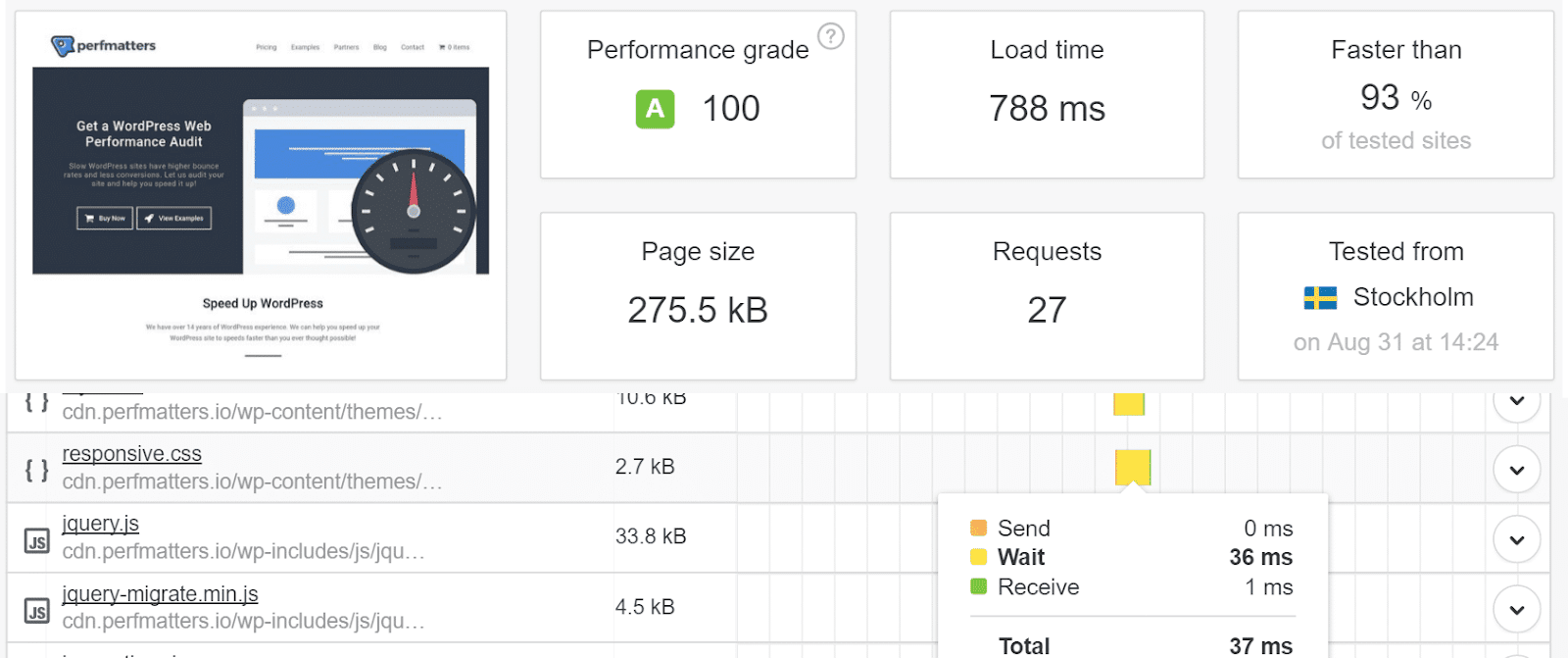
We ran two tests to show the difference in TTFB with and without Kinsta CDN (powered by Cloudflare). We ran each test 5 times and then took the average.
Test 1: TTFB Without CDN
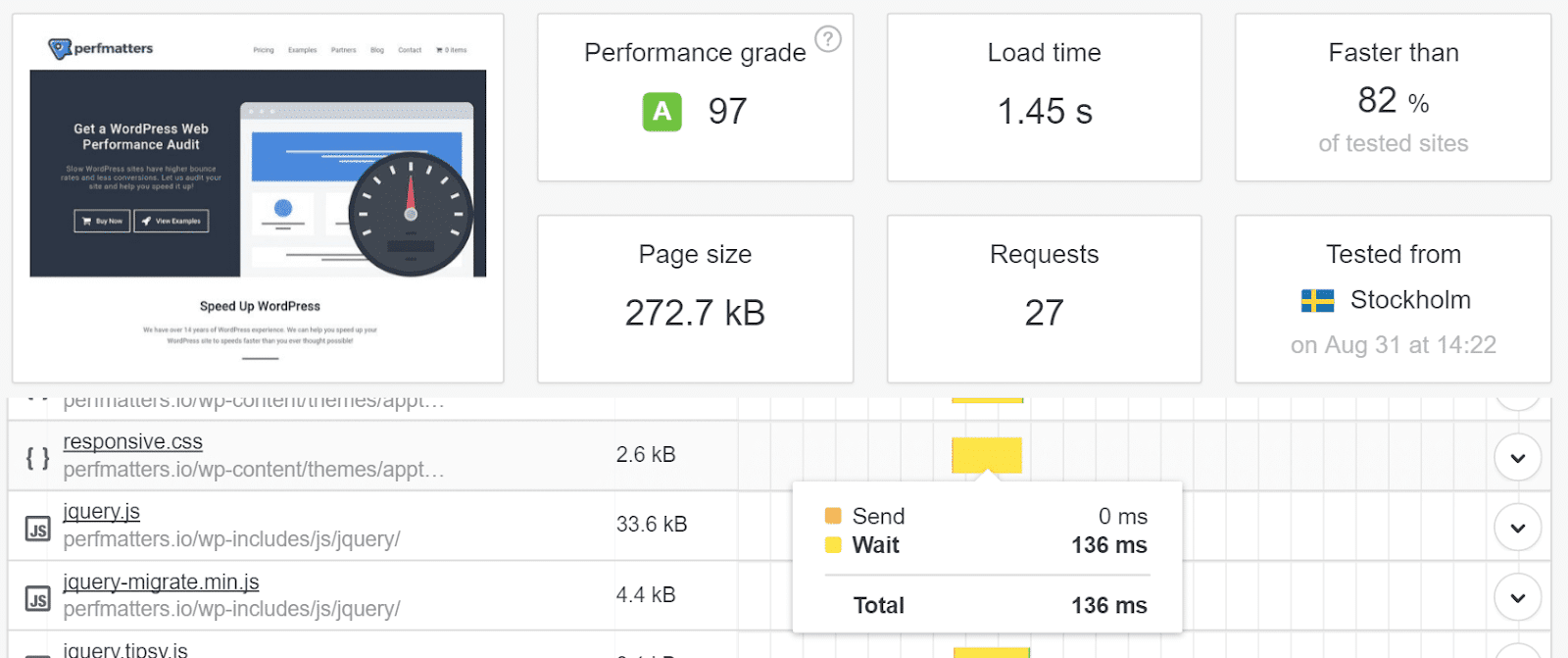
We first ran a Pingdom test with the Kinsta CDN disabled. Here are the results:
- The total load time was 1.45 s
- Average TTFB was around 136 ms
Test 2: TTFB With CDN
We then enabled the Kinsta CDN and ran the test again:
- Total load times dropped down to 788 ms
- Average TTFB improved to 37 ms
What a difference a CDN can make!
Another essential thing to note is that we chose the Stockholm location to perform this test.
Why? Because we wanted to show you the real improvement that can be had by decreasing the physical distance. There is a CDN POP located in Stockholm, so our content is being served from Stockholm.
Faster Delivery With Caching
Similar to how you may use caching with your WordPress host or a plugin, CDNs also utilize caching. That is one way in which they can deliver files so fast.
Important: Once a CDN gets a copy of your media, it has to typically be requested once or twice by a visitor before it’s cached on the CDN.
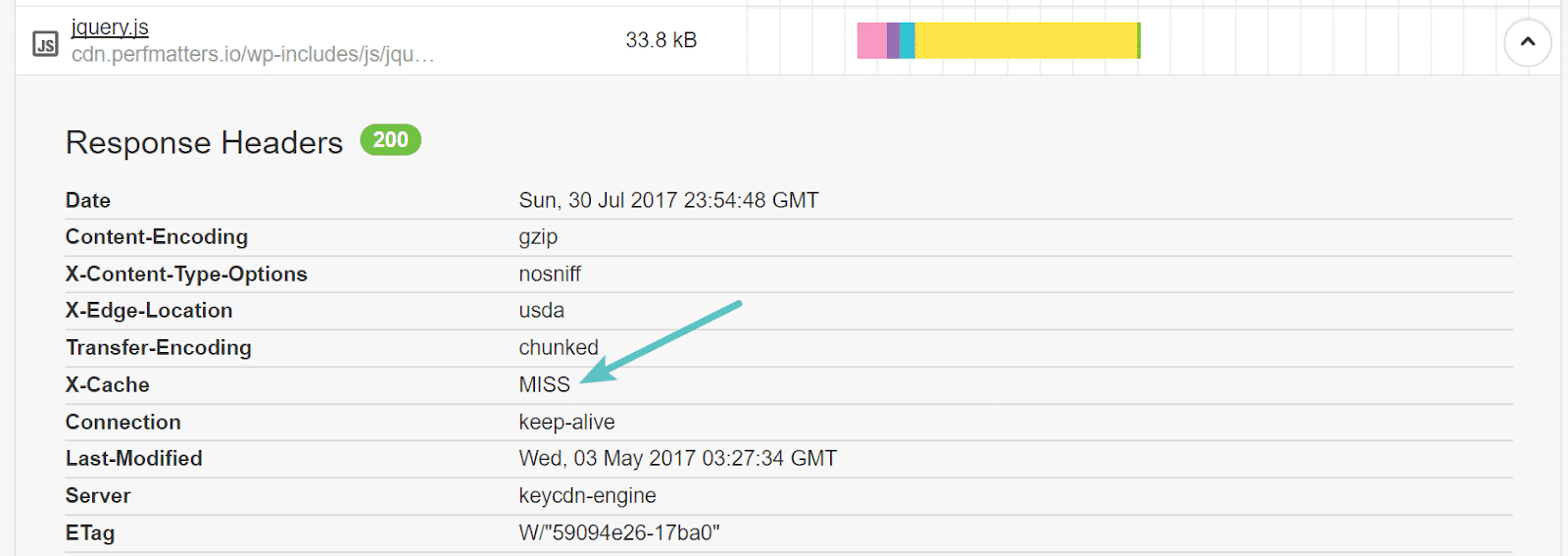
A CDN places an HTTP header on the requests called “X-Cache.” The file usually appears as a MISS on the first or second request, meaning it’s not yet cached.
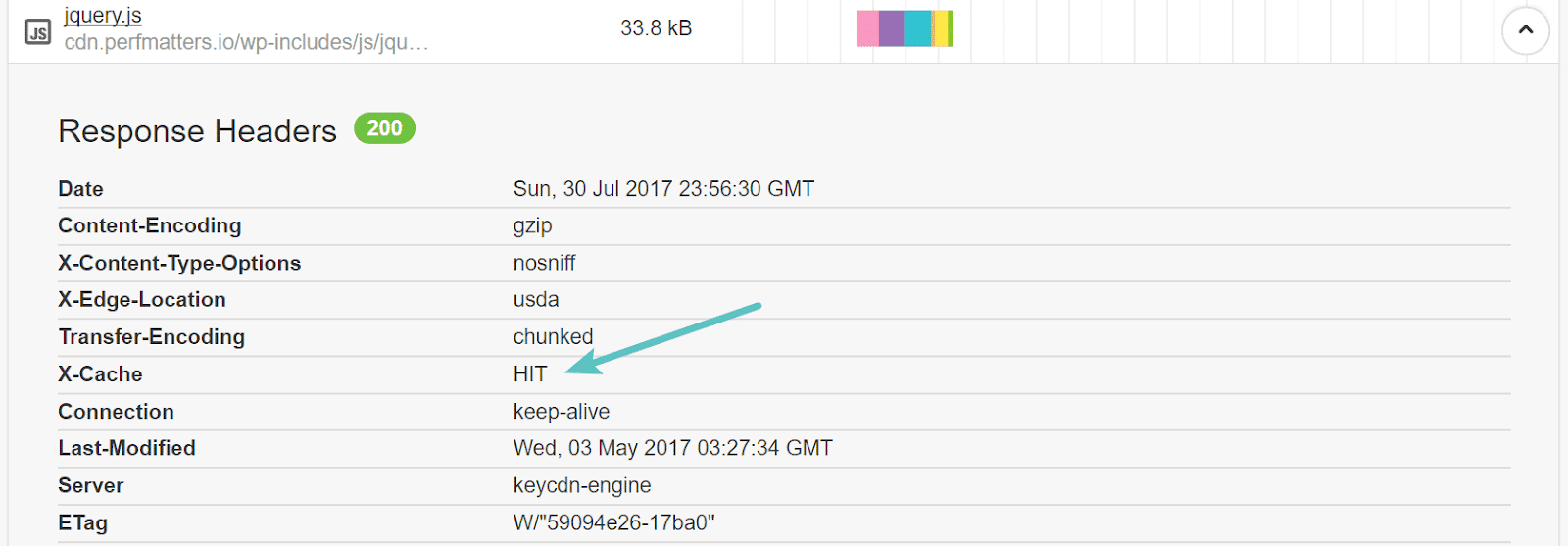
On subsequent requests, it shows up as a HIT, which is now cached on your CDN. It will remain cached based on various factors such as ETag headers, expires headers, or manual purging of your CDN cache.
Using a CDN such as Kinsta CDN, you can take caching to the next level by utilizing what’s referred to as full-page, reverse proxy caching. This involves caching everything on one primary URL instead of a secondary domain.
Huge Savings with GZIP Compression
WordPress CDNs also utilize GZIP, a file format and software application used for file compression and decompression.
GZIP compression is enabled server-side (or on the CDN server/POP) and further reduces the size of your HTML, stylesheets, and JavaScript files.
It will not work on images as these are already compressed differently. Some have seen up to 70% reductions due to compression. It is one of the most straightforward optimizations you could make. And don’t worry, all reputable CDNs have this enabled by default.
HTTP/2
HTTP/2 is also one of the top features that all CDNs utilize to speed up the delivery of assets.
The performance improvement is due to various reasons, such as the protocol being able to support better multiplexing, parallelism, HPACK compression with Huffman encoding, the ALPN extension, and server push.
2. Lower Bandwidth Costs
Another benefit of a CDN is that it can help offload CPU and resources from your hosting server (origin server). This helps:
- Prevent traffic spikes from overwhelming your host
- Decrease your overall bandwidth costs
- Eliminate fluctuations in bandwidth fees due to volatile traffic
The last thing you want is for something to go viral, and you’re left with a high-cost bill from your host or an overage charge.
Another way a CDN helps decrease costs is by providing easy ways to enable hotlink protection. This refers to restricting HTTP referrers and preventing others from embedding your assets.
Some of you may have heard of the Huffington Post fiasco. An author on the Huffington Post copied and pasted images from the Oatmeal’s website, which accrued a $1,000 bill from AWS that was sent to the Oatmeal’s site owner. The owner of the Oatmeal ended up replacing the images so that readers of the Huffington Post article could see them.
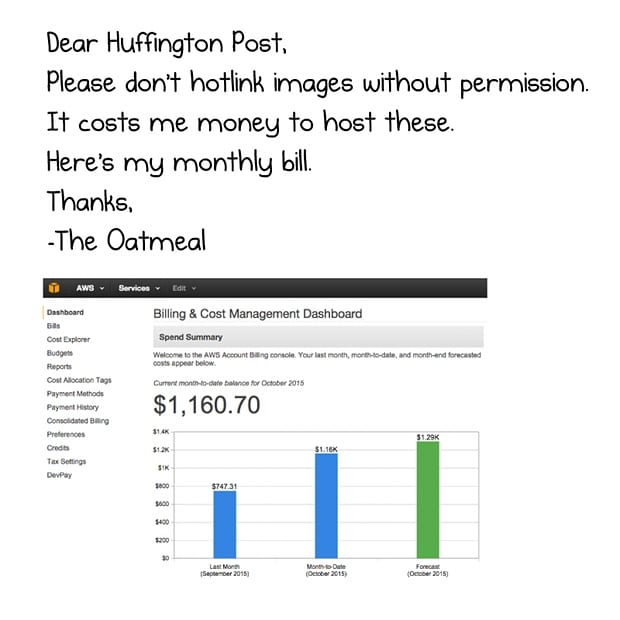
This is why it is always essential to enable hotlink protection. Otherwise, you might end up with an outrageous bill.
3. High Availability and Scalability
CDNs offer high availability and scalability.
Since the replicated content is accessible across multiple POPs at different geographic locations, web traffic gets dynamically routed to another server if one goes down.
And there is no need to worry about scalability because CDN providers are built with that in mind. A CDN could keep your website from crashing if you are utilizing a smaller shared host since it’s handling most of the load.
4. SEO Advantages
Google made site speed a ranking factor back in 2010, so it’s no secret that a faster website could result in higher rankings.
While there is no way to know how much weight is placed on speed, you can safely assume it’s one of the more critical factors since it affects the user experience.
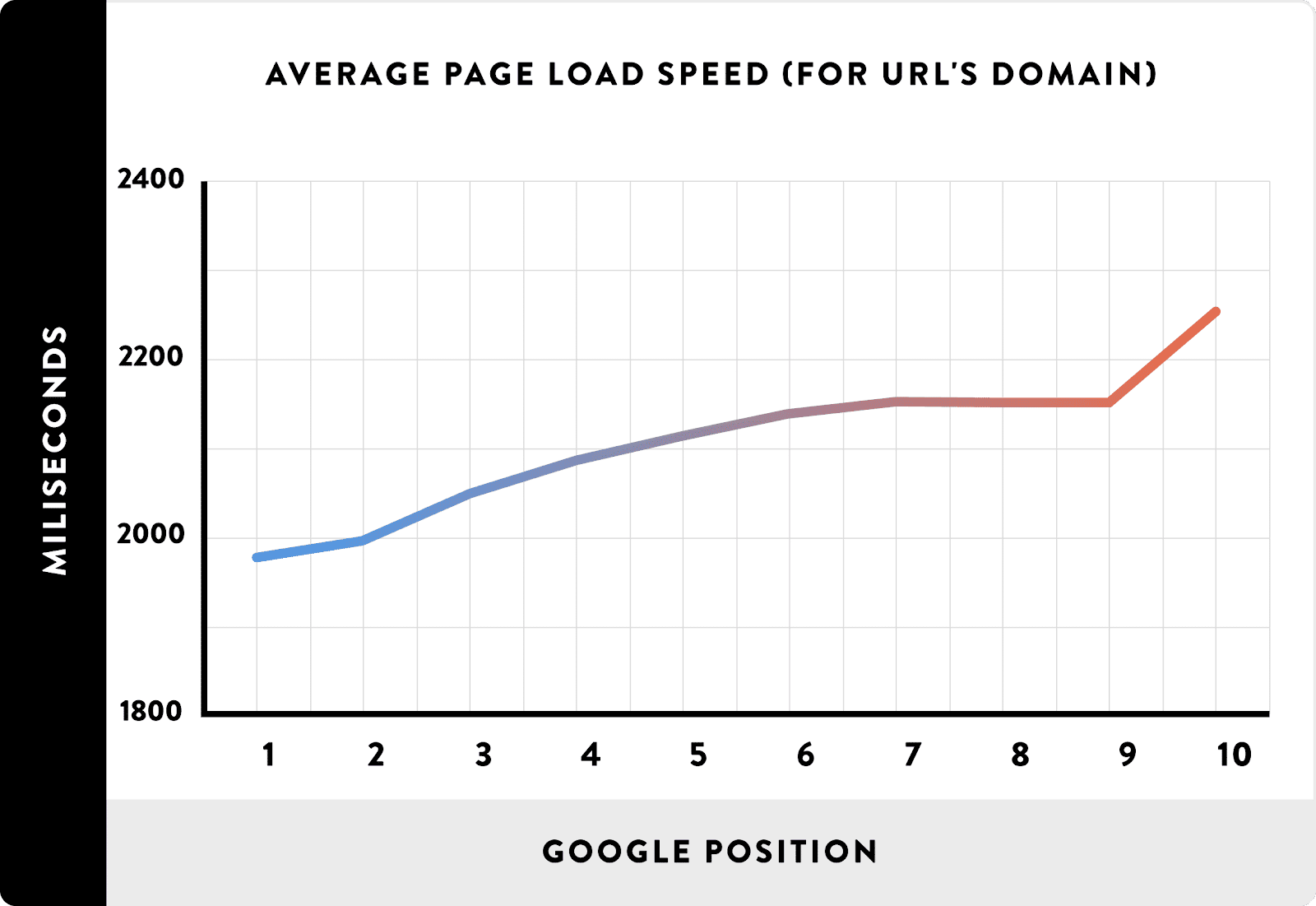
Brian Dean analyzed the top 1 million domains to look at the relationship between site speed and Google rankings and found a positive correlation.
While these tests are almost impossible to prove, you can be assured that having a faster website will only help you in Google. To put it simply, Google rewards fast sites.
Besides improving your website’s page speed, a CDN can increase the crawl rate of your media assets, such as images, which can help improve their indexing in Google Images.
5. Additional Security
Many CDNs provide additional security by allowing you to implement web application firewalls (WAF) and what some call Origin shields. These can help:
- Mitigate DDoS attacks of all forms and sizes, including those that target the UDP and ICMP protocols
- Block SYN/ACK, DNS amplification, and Layer 7 attacks
- Put your site behind a proxy, which hides your origin IP address, although it is not bulletproof
Check out our case study on how to stop a DDoS attack. We had a client with a small ecommerce site running Easy Digital Downloads, which got over 5 million requests to a single page within 7 days.
The site typically only generated between 30-40 MB a day in bandwidth and a couple of hundred visitors per day. But the site instantly went to between 15-19 GB of data transfer a day out of the blue!
That’s an increase of 4650%. And Google Analytics showed no additional traffic. That’s not good.
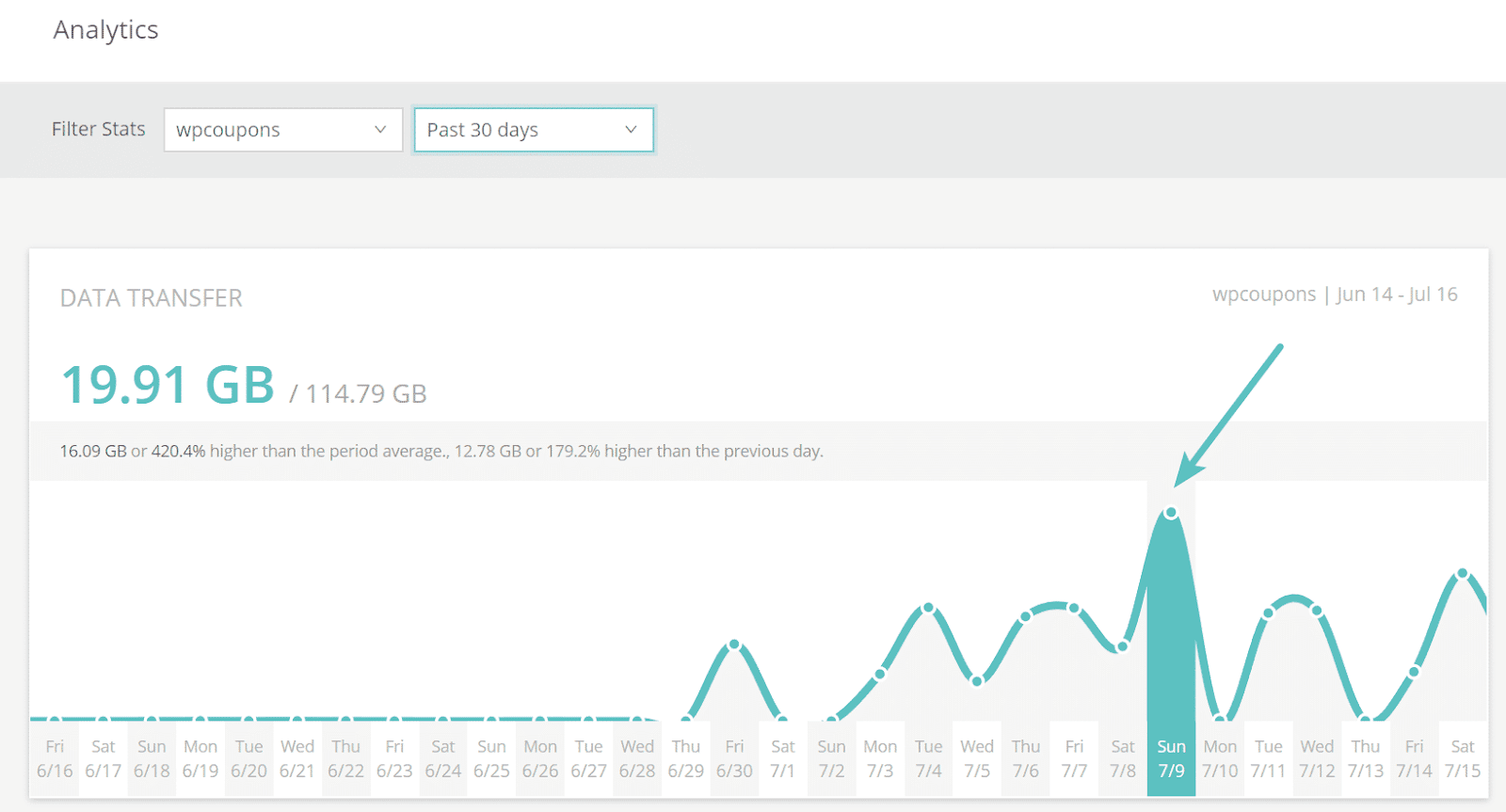
The client implemented Sucuri’s web application firewall on their site, and all of the bandwidth and requests instantly dropped on the site (as seen below), and there hasn’t been a single issue since. So it’s a good investment and time saver if you run into issues like these.

CDNs also provide additional security features such as secure tokens, which allow you to generate secured links with an expiration time.
After it has expired, users can no longer access that content.
Bonus: How CDN Affects Core Web Vitals
Google’s Core Web Vitals measure three things: loading performance (LCP), interactivity (INP), and visual stability (CLS).
A CDN directly affects LCP. LCP measures how long it takes for the largest visible element on a page to load. This is almost always a hero image or a large background image.
Serving that image from a CDN POP close to the visitor rather than your origin server in Iowa shaves substantial time off that first render. For visitors outside North America, this difference can be the line between a passing and failing LCP score.
The impact is less direct for INP and CLS. A CDN doesn’t make your JavaScript execute faster once it’s downloaded, and it doesn’t prevent layout shifts caused by poorly loaded fonts or images without defined dimensions.
But getting assets to the browser faster gives you a head start on all three metrics.
If you’re looking at your Core Web Vitals in Google Search Console and LCP is consistently failing for international visitors, enabling a CDN is the first thing to try.
CDN Speed Tests: With CDN vs Without CDN
Instead of just telling you the benefits of a WordPress CDN, let’s do some tests to show you the results.
- We ran 5 tests from 4 different testing locations with a CDN enabled and then without a CDN.
- The site is hosted with Kinsta and uses the free Kinsta CDN (powered by Cloudflare).
- The physical location of the server is in Iowa, USA.
Important: When you speed-test your CDN, you run it a few times so that the media is cached.
As we described before regarding CDN caching, the X-Cache HTTP header will show a “HIT” once it is cached. If it isn’t cached, it will show a “MISS.” If you don’t do this properly, it might appear that the CDN isn’t helping speed up your site when you didn’t build up the cache first.
Without CDN (Dallas, Texas, USA)
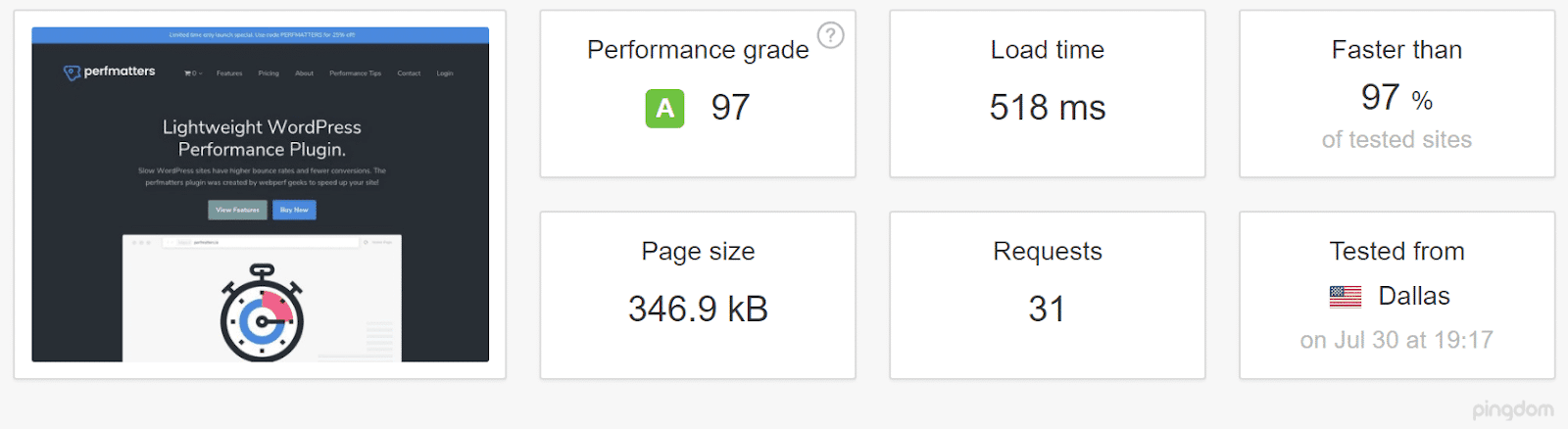
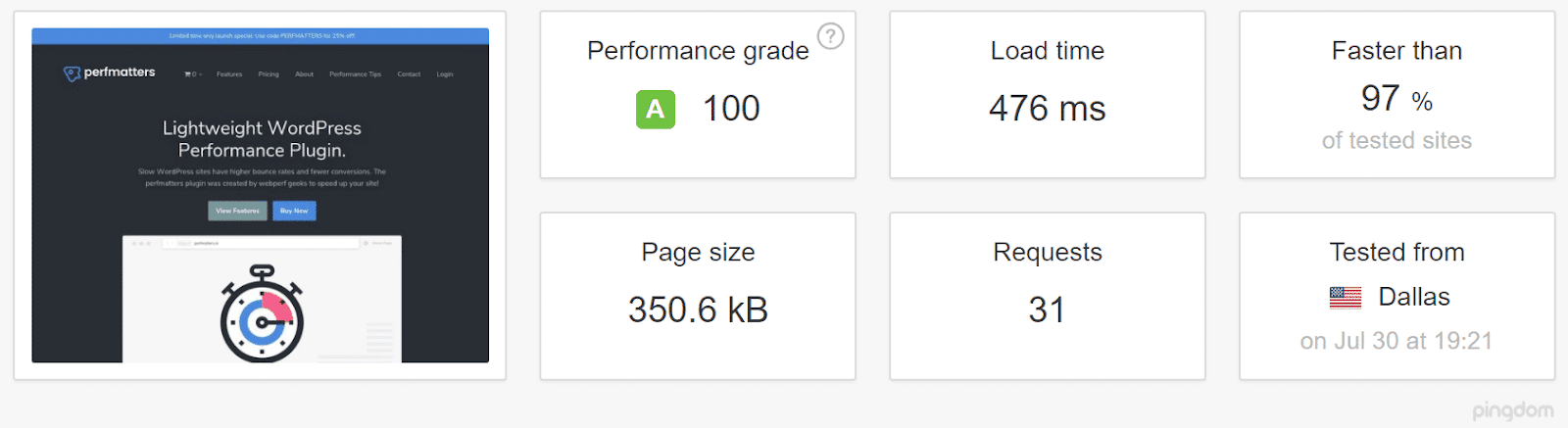
We first ran 5 Pingdom tests using a server in Dallas without a CDN. We then took the average.
Without CDN (Melbourne, Australia)
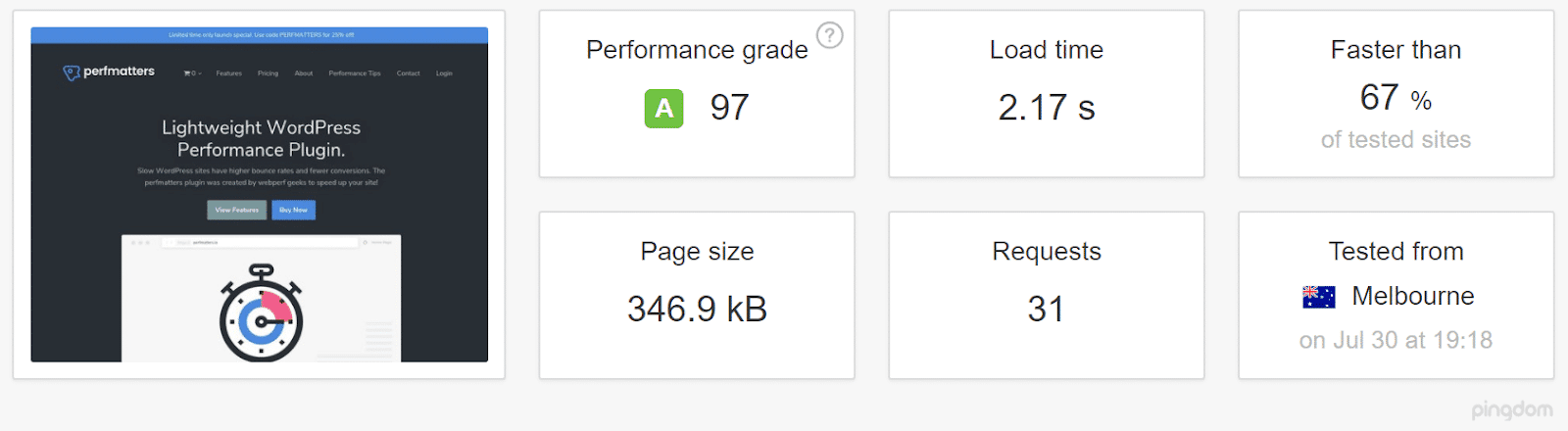
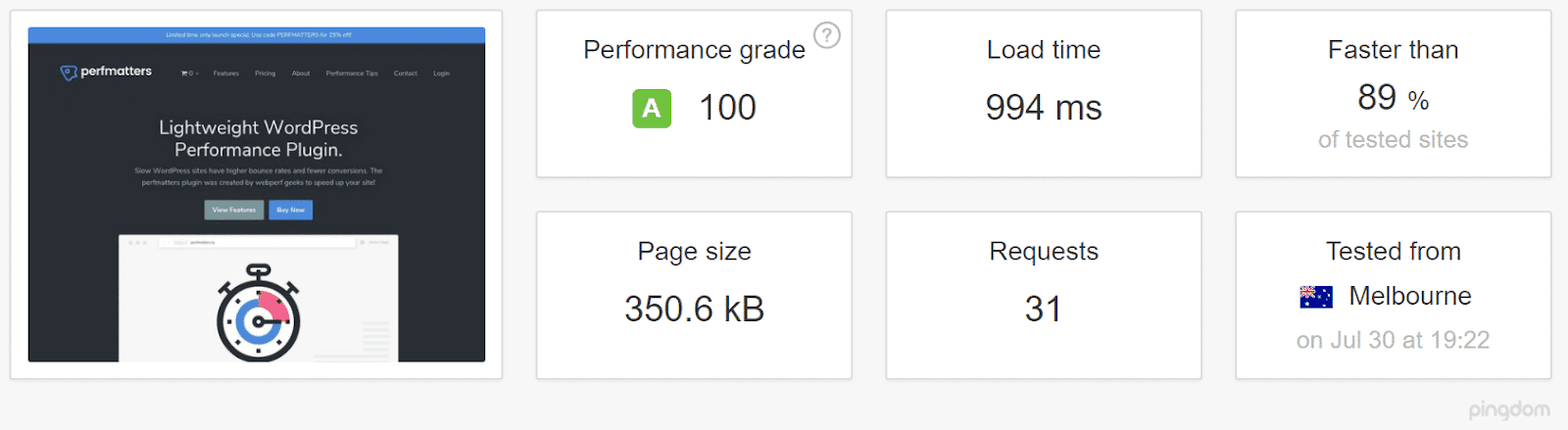
We then ran 5 Pingdom tests using a Melbourne, Australia, server without a CDN. The average was taken as well.
Without CDN (San Jose, California, USA)
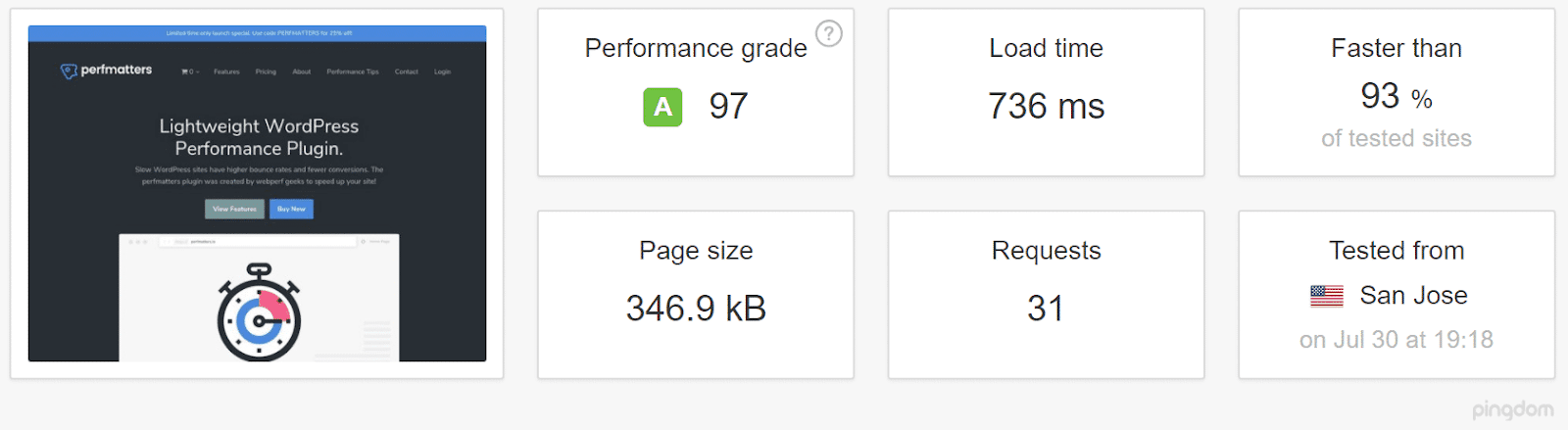
We then ran 5 Pingdom tests without a CDN from San Jose, California, and took the average.
Without CDN (Stockholm, Sweden)
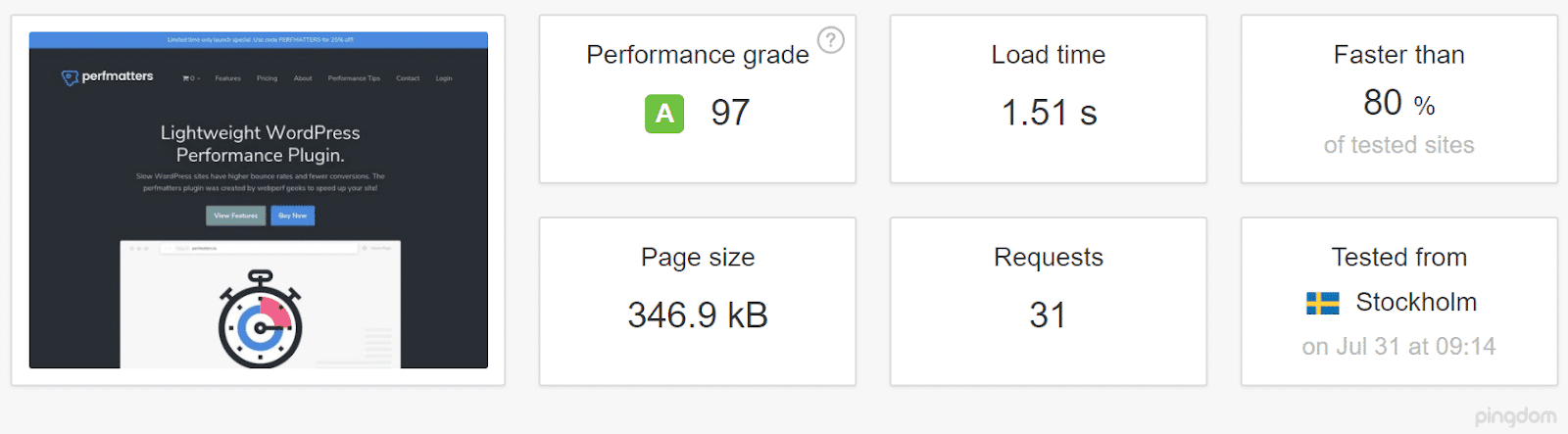
We ran 5 Pingdom tests without a CDN from Stockholm, Sweden, and took the average.
With CDN (Dallas, Texas, USA)
For comparison, we ran 5 Pingdom tests with the active Kinsta CDN from a Dallas, Texas server. The average was taken after.
With CDN (Melbourne, Australia)
We then ran 5 Pingdom tests with the Kinsta CDN from a Melbourne, Australia server, then took the average.
With CDN (San Jose, California, USA)
We also ran 5 Pingdom tests with a CDN using a San Jose, California server and took the average.
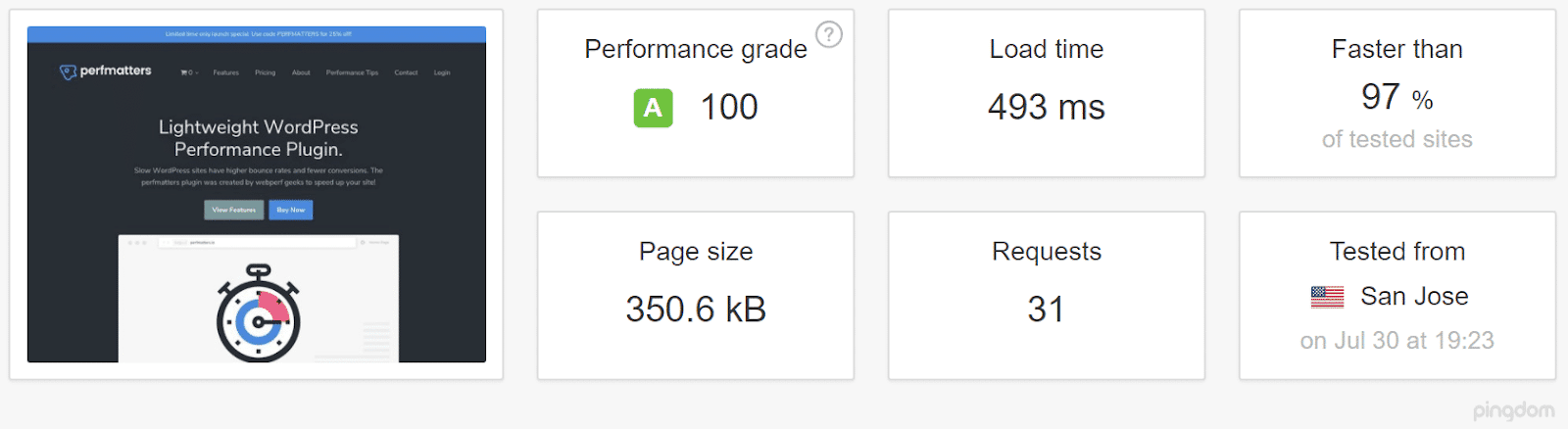
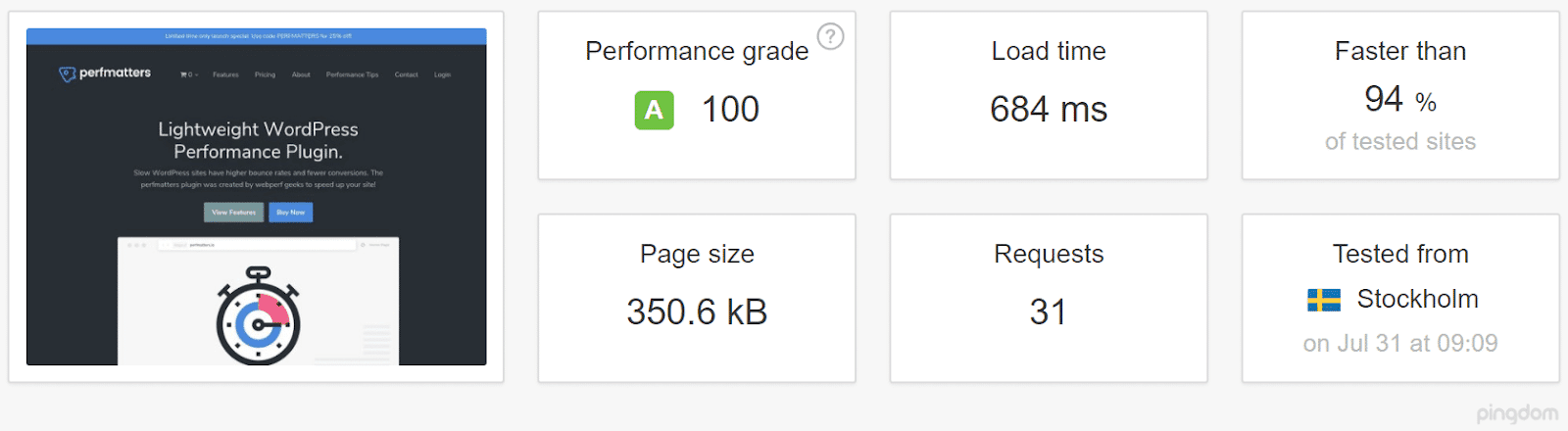
With CDN (Stockholm, Sweden)
We ran 5 Pingdom tests for a Stockholm server with an active CDN. The average was then taken.
The Results
Let’s look at the results to understand how much a CDN affects total load times.
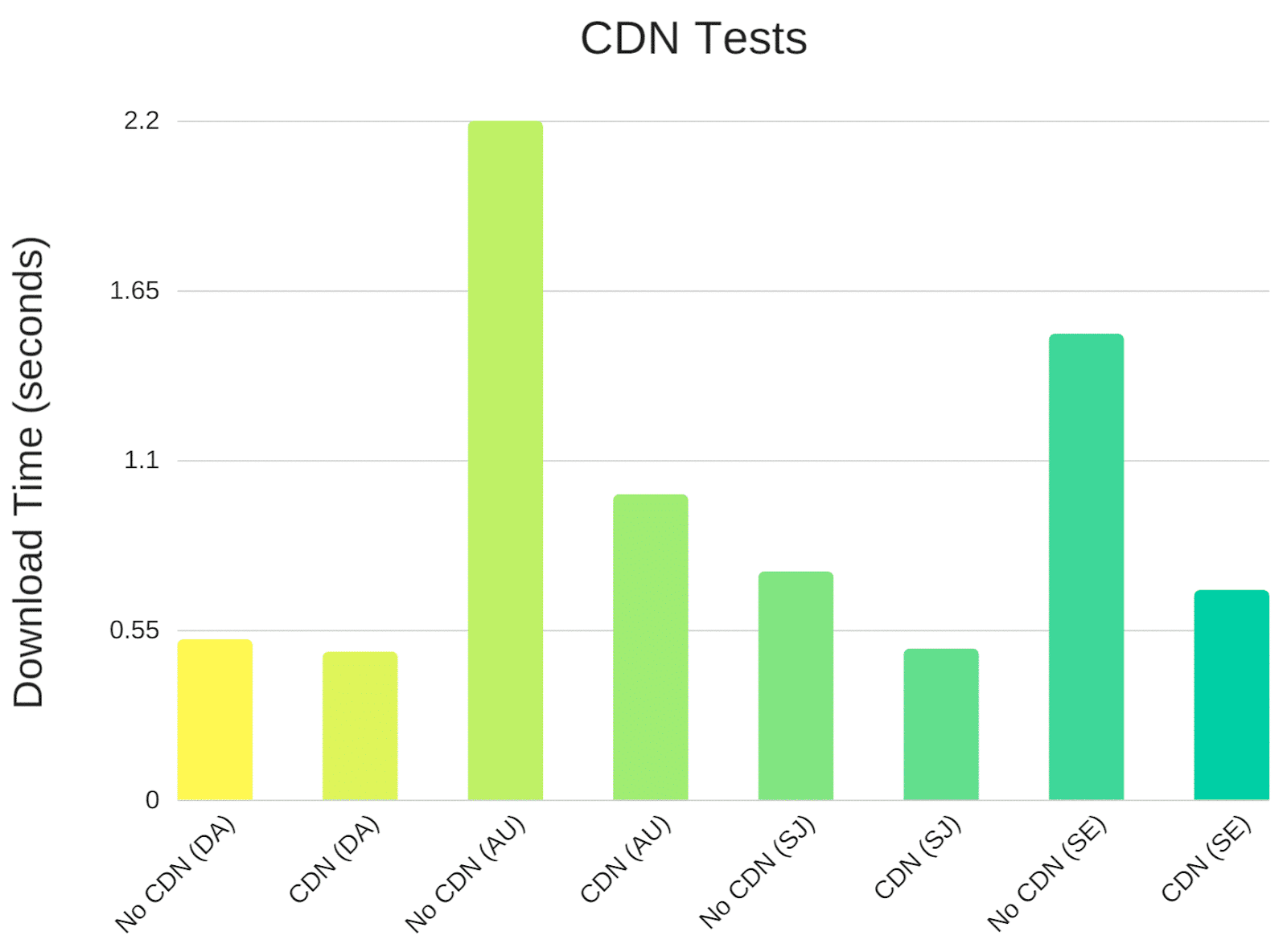
- Dallas, Texas, USA: Decrease 8.11% in total load time with a CDN.
- San Jose, California, USA: Decrease of 33.02% in total load time with a CDN
- Melbourne, Australia: Decrease of 54.19% in total load time with a CDN.
- Stockholm, Sweden: Decrease of 54.7% in total load time with a CDN.
The CDN produced slightly faster page load times with both Dallas and San Jose sites. But if you look at the Australia tests, you can see a huge difference in load times.
This is because of the geographical location of the test server.
The Kinsta test server is in Iowa, so the data doesn’t have that far to travel when loading without a CDN from Dallas and San Jose. But for Australia, the distance is what kills the load times.
When we enable the CDN, the content and media load from a Kinsta CDN POP in Sydney, Australia, which results in much faster download times. The same goes for Stockholm, Sweden.
Now, do you want to decrease your load times by over 50% in some cases? The answer should be yes!
Do You Need a CDN?
We get this question frequently. In our experience, it shouldn’t be a question since a CDN is beneficial in almost every scenario, regardless of your site’s size and traffic.
Just look at all the benefits we listed above. Price is usually no longer a factor as most CDN providers are very cheap, or free with Kinsta CDN. Not to mention, CDNs help improve SEO, site loading, user experience, and more!
The only time you might want to do some further testing is if you are only serving content to visitors in a specific geographical location.
Let’s say, for example, you run a small shop with a website in Ontario, Canada. Perhaps you don’t care as much about customers located elsewhere. You will want to research where a CDN provider’s POPs are located.
If your web server host is located in Ontario, but you sign up for a CDN provider with only its nearest POP in the USA, it could slow your site down. In this scenario, which is very rare, it might benefit you not to use a CDN.
Do I Need a CDN Plugin for WordPress?
If you host with Kinsta, you don’t need a plugin at all.
Kinsta CDN is built in and enabled with one toggle in the MyKinsta dashboard. No configuration, no URL rewriting, no plugin to maintain.
If you’re using a different host and connecting to a third-party CDN, you’ll need a plugin to rewrite your asset URLs so they serve from the CDN domain instead of your origin.
The two most commonly used options for this are WP Rocket and W3 Total Cache.
WP Rocket ($59/year for one site) is the simpler of the two. It has a dedicated CDN tab in its settings where you enter your CDN URL, and it handles everything from there. W3 Total Cache has a free version and is more configurable, but the settings are denser. For most people, WP Rocket is the faster path.
Cloudflare is a slightly different case. Because it operates as a full reverse proxy, it doesn’t require a URL rewriting plugin. You point your DNS to Cloudflare and the CDN layer activates automatically.
Some WordPress users also install the official Cloudflare plugin to manage cache purging from the WordPress dashboard, but it’s optional.
One plugin worth mentioning: Optimole. It’s an image CDN specifically, useful if your site is image-heavy and you want CDN delivery for images without changing your hosting setup. The free plan covers up to 5,000 monthly visitors.
Popular CDN Providers
Although there are a lot of great CDN providers out there, Kinsta offers a CDN built into its hosting; it’s powered by Cloudflare, fast, easy to activate, and entirely free for Kinsta users.
You get Cloudflare’s global network of 300+ edge locations with zero setup. It serves static assets (images, CSS, JS) from whichever POP is geographically closest to your visitor.
Kinsta also includes edge caching, which goes further than a standard CDN. It caches full HTML pages at the edge rather than just static files, which means your server handles dramatically fewer requests even for dynamic WordPress content.
We recommend taking advantage of our free Cloudflare integration, but we understand that some site owners require an external CDN or proxy for specific reasons.
In that case, we encourage you to explore some other top CDNs, all of which are compatible with Kinsta hosting (click on the links to see Kinsta integration documentation for each one):
How To Install a CDN in WordPress
Each CDN provider has its integration method, but thankfully they all support WordPress and make it easy to integrate. Check their documentation or ask their support team if you have trouble.
Kinsta CDN
We partnered with Cloudflare, an HTTP/2 and IPv6-enabled content delivery network with 300+ locations, to turbocharge your assets and media around the globe. Currently served regions include America, South America, Europe, Africa, Asia, and Australia.
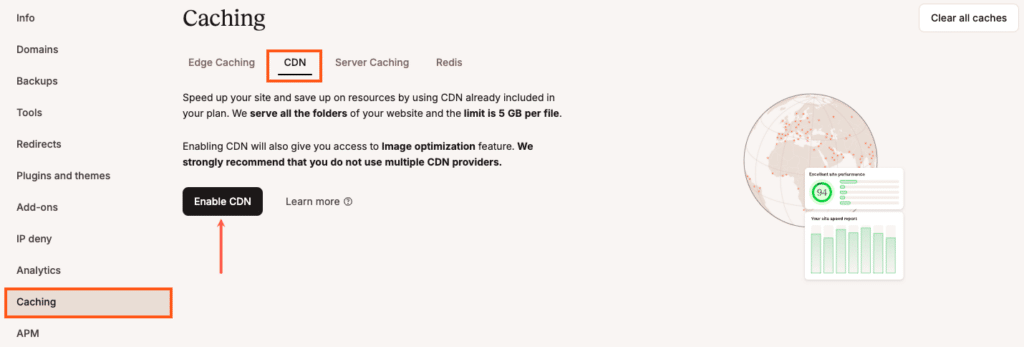
Check out how to enable the Kinsta CDN. It’s a simple one-click process from within the MyKinsta backend dashboard.
We also have amazing site analytics to see bandwidth usage, top files by requests, HTTP status codes, and more.
Within the MyKinsta dashboard, you can view analytics at a company level (aggregating data from all of your sites) and at a site-specific level.
Cloudflare
If you are using or interested in Cloudflare for a site not hosted on Kinsta, we have an in-depth tutorial on how to install Cloudflare on your WordPress site.
However, keep in mind that all Kinsta hosting users receive a free CDN powered by Cloudflare, so it’s easier to go with that method instead of installing it as a separate component.
As part of our Cloudflare integration, Edge Caching saves your Kinsta site/page cache to any of Cloudflare’s global network of 300+ data centers.
Edge Caching is included free with all Kinsta plans, doesn’t require a separate plugin, and cuts the time needed to serve cached WordPress HTML by an average of more than 50%!
Third-Party CDN
If you are looking into deploying a CDN yourself, we recommend using a subdomain for your media and assets instead of the provider’s random URL.
Example: cdn.yourdomain.com.
This will ensure better branding for your site as well as fewer hassles when it comes to indexing issues.
After setting up your CDN at the provider, you can utilize a free WordPress plugin to link your assets quickly and automatically copy them to your CDN provider. View our list of recommended WordPress CDN plugins below.
Top CDN Plugins and Extensions

These CDN plugins don’t automatically activate a CDN on your WordPress website, but rather connect a third-party CDN provider (like Cloudflare, Fastly, or Sucuri) to your WordPress site, allowing the CDN to access site assets and deliver that content to visitors.
Overall, the best WordPress CDN plugins make the connection easy for you, providing a one-click solution instead of a complicated integration.
Here are the best WordPress CDN plugins:
- Cloudflare: This is the right choice if using Cloudflare as your CDN provider, especially since it offers a one-click installation, a web application firewall setting, and an automatic platform optimization tool, which speeds up sites dramatically with over 250 fast and reliable data centers. Alternatively, you can opt for Kinsta CDN, which is already powered by Cloudflare and doesn’t require the extra plugin!
- Bunny.net: Both a CDN provider and a WordPress CDN plugin, Bunny.net offers a quick integration to replace links and add them to your CDN. You gain quick performance improvements with automated HTTPS configuration, custom CDN hostnames, and the ability to exclude specific directories from getting served through your CDN.
- LiteSpeed Cache: Before anything else, this is a caching plugin. But it also comes with a free QUIC.cloud CDN cache, or you could link to any CDN provider. You can improve your site’s performance with a wide range of features along with minification, image optimization, and lazy loading.
- W3 Total Cache: Many caching plugins also double as CDN WordPress plugins, and W3 Total Cache is no different. Integrate with some of the most popular CDN providers to instantly boost your site performance without any complicated settings. This sends elements like media items and theme files to the CDN while also caching and compressing those files before use within the CDN.
- CDN Enabler: This plugin rewrites all of your URLs so that assets get served from your external CDN. You can link to a KeyCDN account and take advantage of cache purging, performance enhancements, and more.
Indexing Images with CDN
You want to ensure that Google still indexes your images when moving to a CDN.
For users of the Yoast SEO plugin, you will want to add the following code to the bottom of your functions.php file. Replace the domain and CDN domain with your own.
function wpseo_cdn_filter( $uri ) {

return str_replace( 'http://yourdomain.com', 'http://cdn.yourdomain.com', $uri );

}

add_filter( 'wpseo_xml_sitemap_img_src', 'wpseo_cdn_filter' );
If you don’t do this, it could result in your images getting de-indexed (as seen below). You can always check this yourself in Google Search Console.
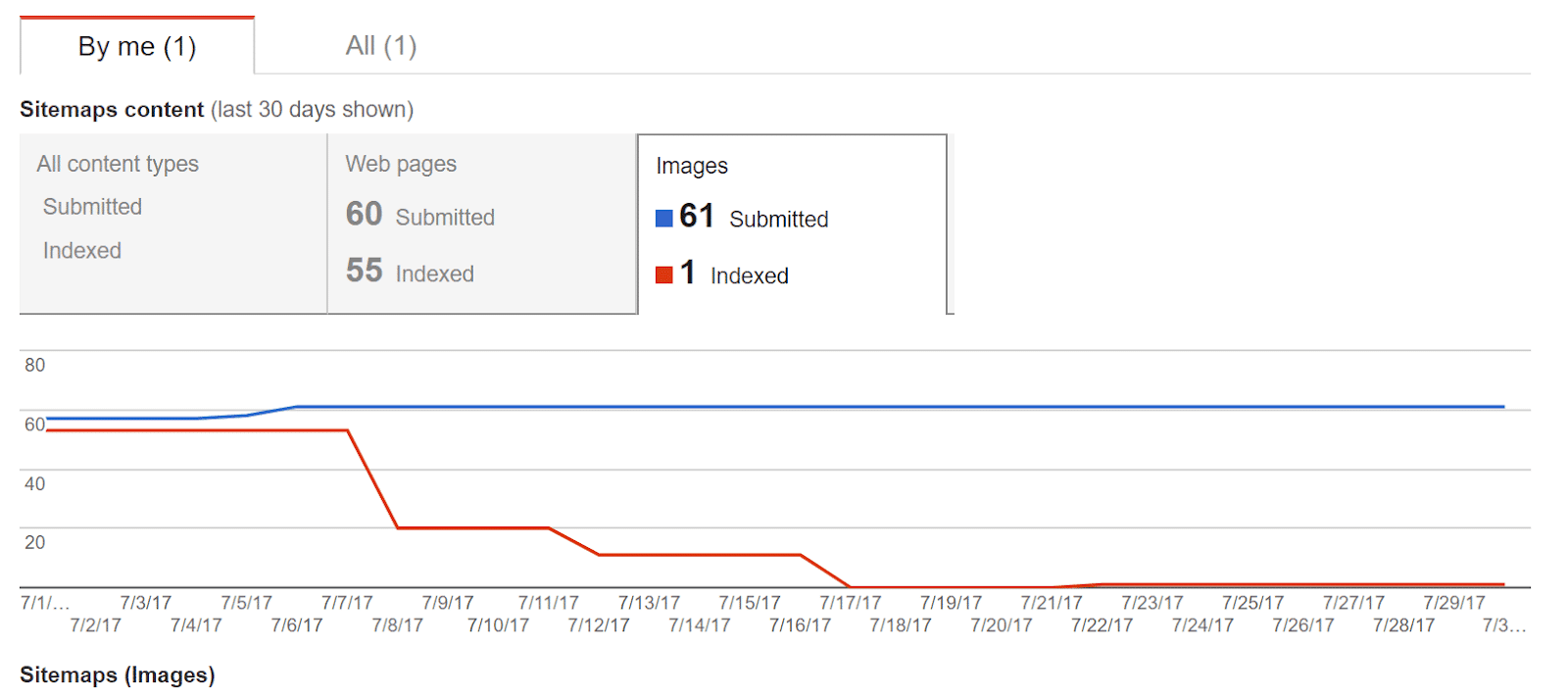
However, Google Search Console has flaws and sometimes fails to report indexed images when they appear on Google. An excellent way to check if your images are indexed is to head over to Google Image Search and input the following: “site:https://yourdomain.com.”

Important: Don’t put in your CDN URL. Even though images are served from the CDN, they should still index on your root domain.
If your images appear in Google Image Search, they are indexed just fine.
FAQs
Do I need a CDN if my host is already fast?
Yes, for international visitors. Even the fastest host is limited by physical distance. If your server is in the US and someone visits from Australia, the round-trip adds latency that no amount of server optimization can fix. A CDN closes that gap. For visitors close to your origin server, the improvement is smaller but still measurable.
Is Cloudflare a CDN?
Cloudflare is a CDN among other things. It also functions as a DNS provider, a firewall, a DDoS mitigation service, and a reverse proxy. Most people encounter it as a CDN first, but the free plan includes all of those features together.
What’s the difference between a CDN and web hosting?
Your web host stores your website and processes dynamic requests, like page generation or database queries. A CDN caches static copies of your files and delivers them from servers close to your visitors. They work together. You can’t replace your host with a CDN.
Is a CDN free for WordPress?
It depends on your host. Kinsta includes CDN on every plan at no extra cost. Cloudflare has a functional free tier. Bunny.net charges per gigabyte of bandwidth but at rates so low that most sites pay a few cents a month. There are genuinely free options available.
Does Kinsta include a CDN?
Yes. Kinsta CDN is powered by Cloudflare’s network and included with every plan. You enable it from MyKinsta with one click. It serves static assets from 300+ global edge locations and pairs with Kinsta’s edge caching, which goes a step further by caching full HTML pages at the edge.
Summary
If your WordPress site is slow for visitors outside your server’s region, a CDN is the most direct fix available.
Better LCP scores, lower TTFB, less load on your origin server. The gains are real and they compound with everything else you’re doing for performance.
Kinsta CDN is included on every hosting plan, powered by Cloudflare’s global network, and takes about 30 seconds to enable in MyKinsta. If you’re not on Kinsta yet, take a look at our plans and see what’s included.