Add as a preferred source on Google
The WordPress admin dashboard, often called WP Admin or WP admin panel, is essentially the control panel for your entire WordPress website. It’s where you create and manage content, add functionality in the form of plugins, change styling in the form of themes, and lots, lots more.
If you’re using WordPress, the WordPress admin panel is going to be a big part of your life. For that reason, it’s important to understand where to find the WordPress admin, what it lets you do, and how you can use it to manage your site.
How Do You Access The WordPress Admin Dashboard?
By default, you can always find the WordPress admin dashboard by appending /wp-admin to the URL of your WordPress installation. Most of the time, that means you can find the WordPress admin at:
https://yourdomain.com/wp-admin
How Do You Log Into Your WordPress Admin Area?
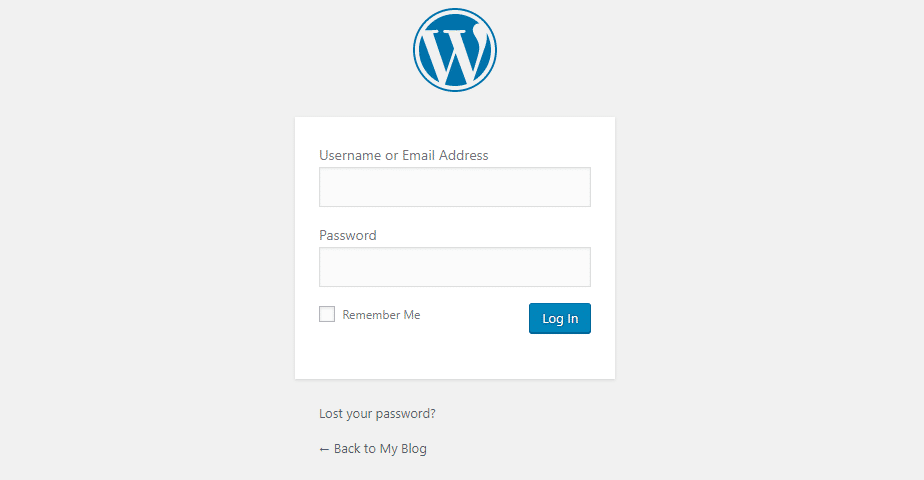
If you’re not already logged in and you try to access your admin dashboard by appending /wp-admin, WordPress will automatically redirect you to the WordPress admin login page without any further action required on your part.
But you can also always manually go straight to the WordPress admin login page URL by visiting:
https://yourdomain.com/wp-login.php
If WordPress is installed on a subdomain, your login URL will look like this: https://blog.yourdomain.com/wp-admin
If WordPress is installed in a subdirectory (like yourdomain.com/wordpress/), include the folder name: https://yourdomain.com/wordpress/wp-admin
We do recommend changing the default login URL. Why? Because all of the bots, hackers, and scripts out there scan for this common URL.
Changing it to something else can be a simple and very effective way to drastically decrease the number of bad login attempts to your website. You can make yourself less of a target, better protect yourself against brute force attacks, and decrease the bandwidth used by the bots that hit this URL repeatedly.
This is not a fix all solution, it is simply one little trick that can harden your security. You can reset your WordPress password by clicking the “Lost your password?” button.
Check out our tutorial on how to change your WordPress login URL.
Locked out of your WordPress admin dashboard? Here’s what to do.
One common source of confusion: if you’re using WordPress.com (the hosted service), your login is at wordpress.com/log-in, not your own domain.
If you installed WordPress yourself (self-hosted), you always log in at your own domain using the URLs above. These are two completely different products with separate login systems.
How Do You Use The WordPress Admin Area?
When you first sign into the WordPress admin dashboard, you’ll see the default screen with widgets such as activity, quick draft, WordPress events and news, and at a glance. This screen gives you a quick overview of all the details for your WordPress website:
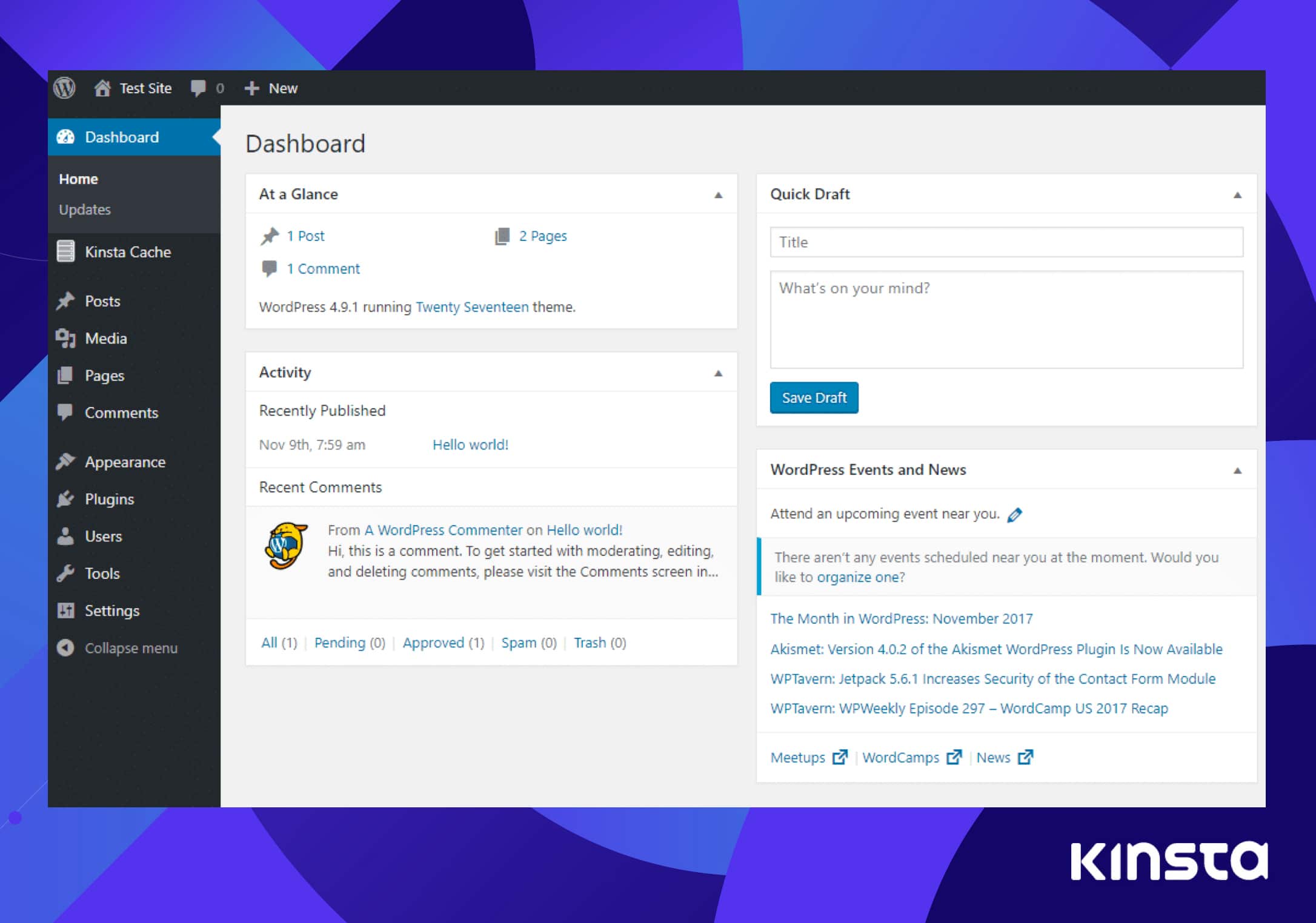
But while the dashboard page is good for a quick overview, you’ll spend most of your time in other areas of the WordPress admin dashboard.
To access those areas, you can use the various menu options in the sidebar. WordPress includes a number of options by default, but many themes and plugins add additional menu items (so you might see something slightly different on your own WordPress site):
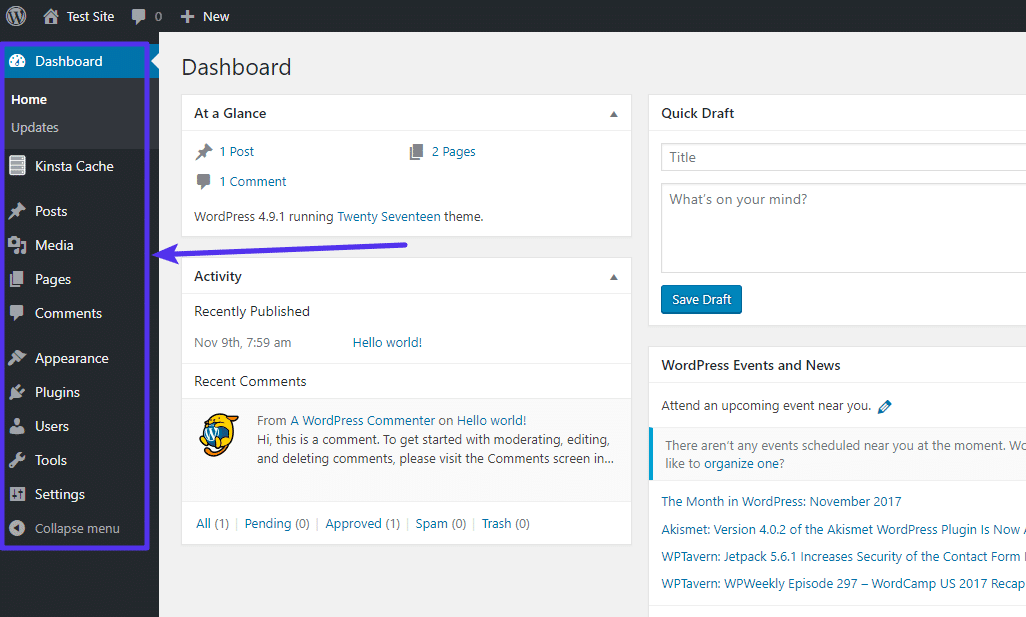
For example, in the screenshot above you can see that we add a special menu item specifically for Kinsta Cache to help our customers automatically manage the server-level caching that we implement for them.
Creating A New Blog Post With The WordPress Admin Panel
Let’s say you want to write your first blog post using WordPress. Here’s how the WordPress admin area helps you do that:
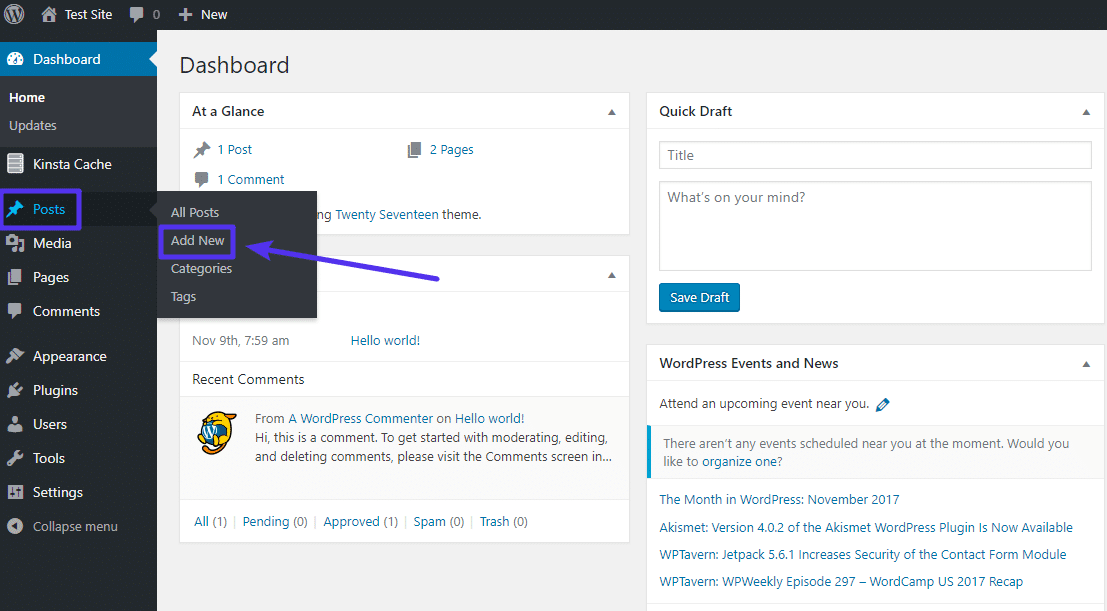
First, you’d hover over the Posts menu item to reveal a set of submenu items. Then, you’d click on the Add New button:
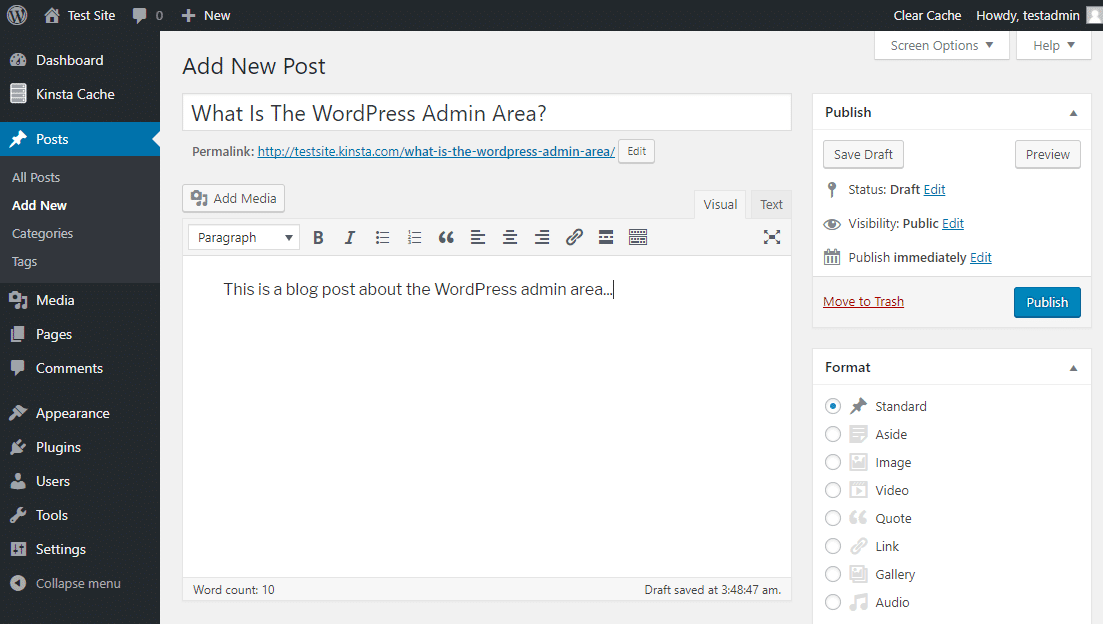
This opens up the Add New Post screen where you can enter a title, write your blog post in the text editor, upload images, assign categories, and more:
Managing How Your Website Looks With The WordPress Admin Area
Another thing that the WordPress admin area lets you do is modify how your WordPress site looks by choosing and customizing “themes.”
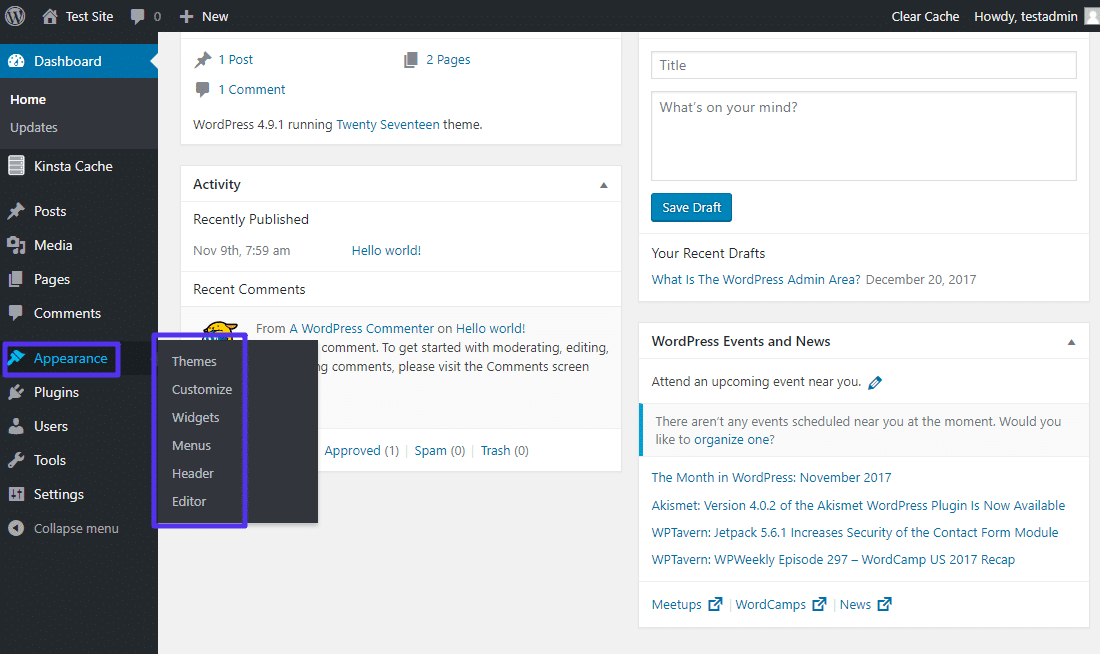
To work with WordPress themes, you just need to hover over the Appearance menu item to expand a list of theme options:
Plugins, Settings, Users, Comments, And Lots More!
By exploring the other menu and submenu items of the WordPress admin panel, you can control pretty much every aspect of your WordPress site, from settings to users, plugins, comments, and most everything else!
WordPress User Roles: Who Can Do What in the Admin?
WordPress has five default user roles, each with a different level of access to the admin dashboard. Understanding them is important whether you’re running a solo blog or a multi-author site with a team.
Administrator
Full access to everything. Administrators can install plugins and themes, manage all users, change site settings, and delete any content. There should only ever be one or two trusted Administrators on any site.
Editor
Can create, edit, publish, and delete any post or page on the site, including content written by other users. A good role for senior team members or managing editors.
Author
Can write, edit, and publish their own posts only. They can also upload media and delete their own posts, but they can’t touch anyone else’s content.
Contributor
Can write and edit their own posts, but can’t publish them. A Contributor’s work has to be reviewed and published by an Editor or Administrator. No media upload access.
Subscriber
The most limited role. Subscribers can only manage their own profile. This role is mostly used on membership sites where users need a login to access certain content.
You can assign and change roles by going to Users → All Users in the admin dashboard. Some plugins even let you create custom roles or modify what each default role can do.
How to Secure Your WordPress Login Page
Because the WordPress login URL is publicly known, it’s a frequent target for bots and brute force attacks. A few simple steps can significantly reduce your risk.
- Use a strong, unique password: Avoid anything predictable. WordPress has a built-in password generator when you create or edit a user. Use it, or use a password manager to generate one.
- Enable two-factor authentication (2FA): 2FA requires a second verification step (usually a time-based code from an app like Google Authenticator) before granting access, even if someone has your password.
- Limit login attempts: By default, WordPress allows unlimited login tries, which makes it easy for automated attacks to keep guessing. A plugin like Limit Login Attempts Reloaded will block an IP address after a set number of failed attempts.
- Change your login URL: As mentioned above, we recommend moving your login page away from the default
/wp-login.phpaddress to make it harder for automated scripts to find it.
Can You Change How The WordPress Admin Panels Looks And Functions?
Yes! There are a number of methods that you can employ to change how the WordPress admin panel looks and functions. We’ll go through a couple of the most common:
Hiding Admin Panel Elements That You Don’t Use
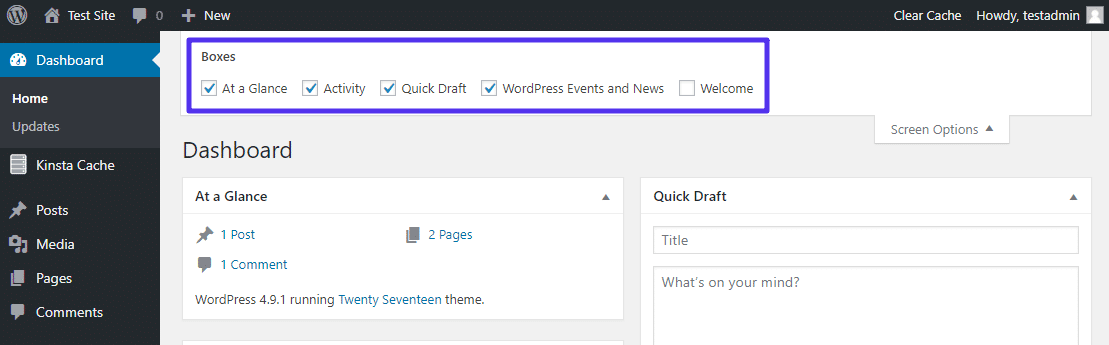
If there are some elements that you don’t use, WordPress lets you hide them to simplify your workflow. To do it, click on the Screen Options button in the top-right corner of any WordPress admin page:
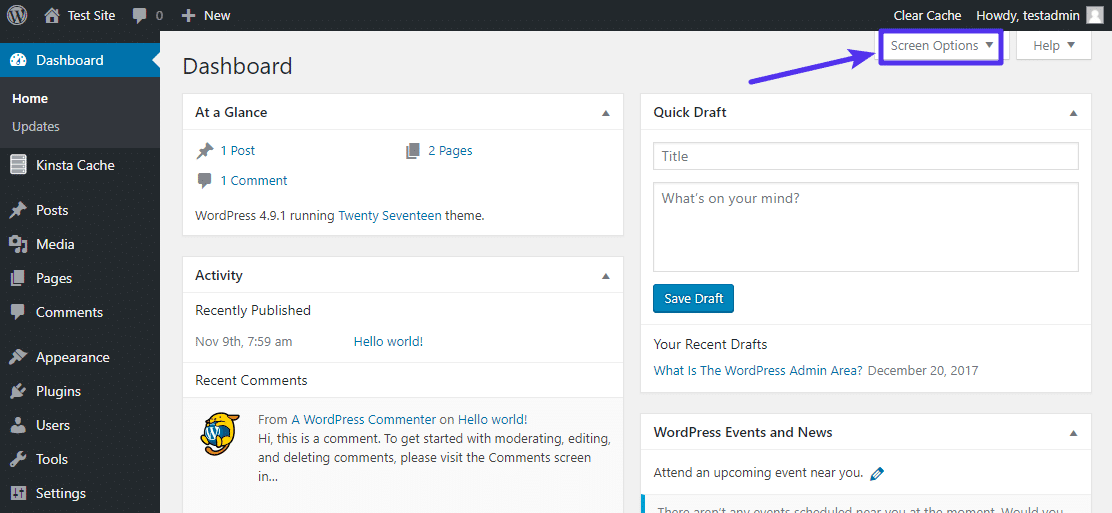
Then, uncheck the boxes for the items that you no longer wish to see:
Changing Color Schemes For The WordPress Admin Panel
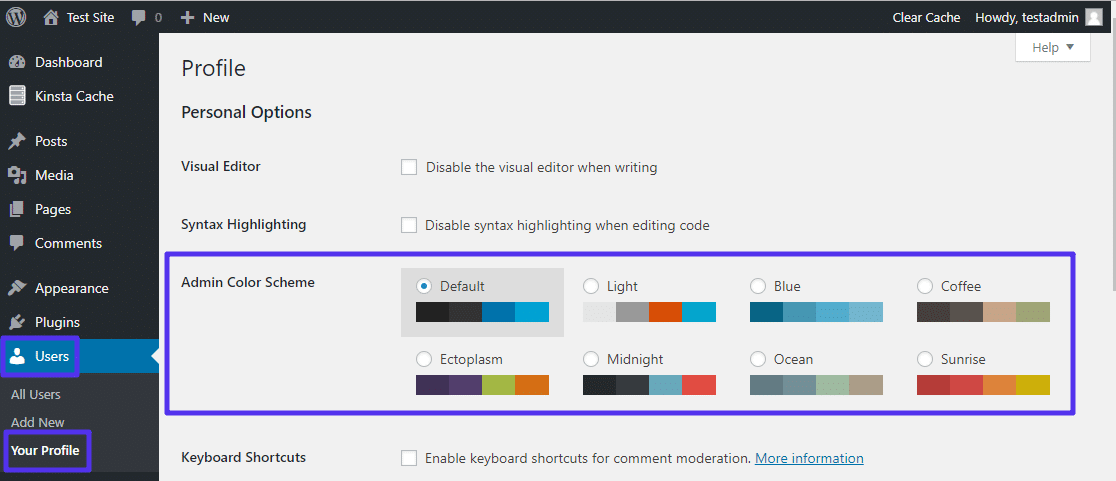
On a more aesthetic front, you can change the actual website color scheme for your WordPress admin panel by going to Users → Your Profile and selecting a new Admin Color Scheme:
And you can also find WordPress plugins that let you use admin themes for more advanced style changes.
What Is The WordPress Toolbar?
The WordPress Toolbar, formerly known as the Admin Bar, is a small bar at the top of your screen that’s present both when viewing the live version of your website and when browsing the WordPress admin panel (assuming you’re logged in to WordPress).
Regular visitors to your site will not see the Toolbar. But if you’re logged into WordPress, you’ll see a floating bar like this on every page on your site:
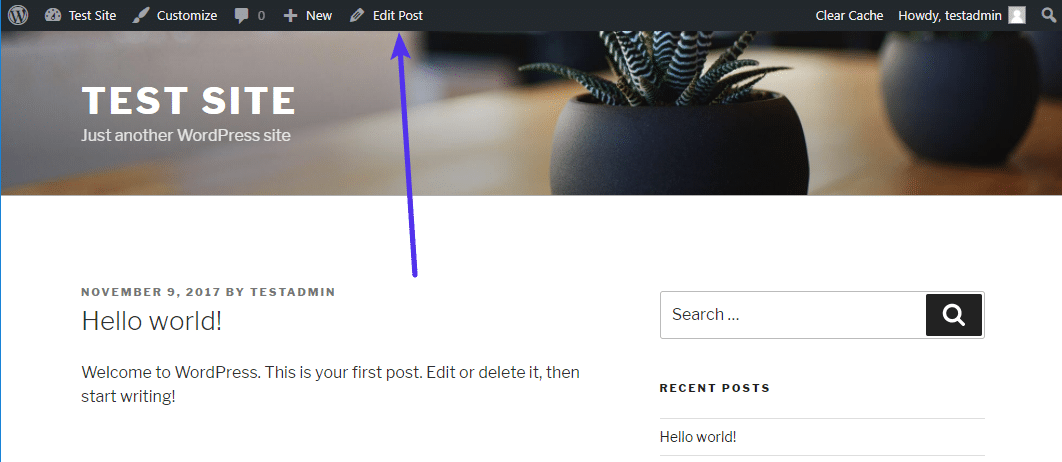
You can use the various menu options on the Toolbar to quickly perform actions, no matter where you are on your site.
Can You Turn Off The WordPress Toolbar?
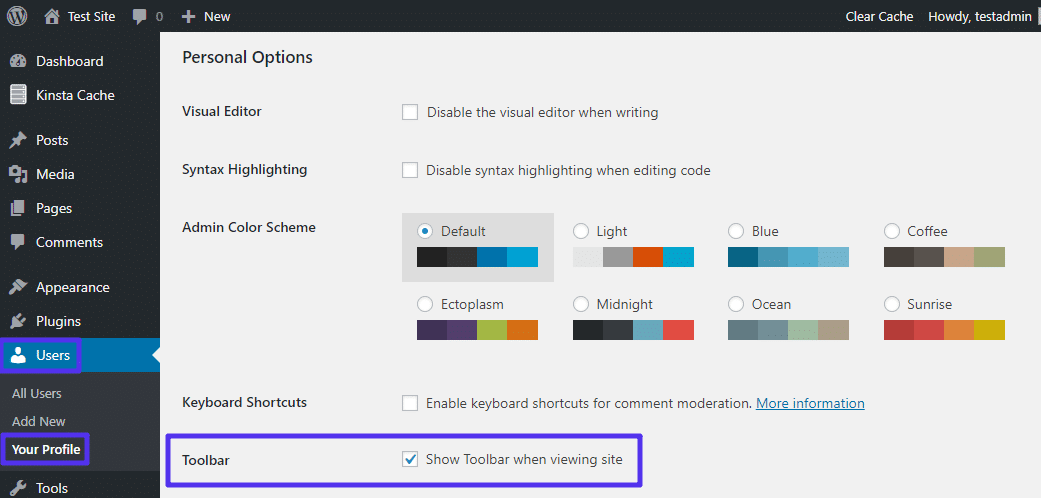
Yes! If desired, you can turn off the WordPress Toolbar by going to Users → Your Profile and unchecking the box for Show Toolbar when viewing site:
Further WordPress Admin Customization
Customizing the WordPress admin dashboard can come in quite handy when you’re working with clients. Or perhaps you just want to simplify things for yourself. There are a lot of things that can be done, such as:
- Hiding or changing things in the admin menu.
- Organizing things via drag and drop.
- Hiding the WordPress toolbar, or hiding it only for non-admins.
- Branding the dashboard with your logo and colors.
- Creating entirely new custom menus.
We recommend checking out some of these free plugins:
Test It Out With A WordPress Admin Demo
If you’re interested in playing around with the WordPress admin dashboard, OpenSourceCMS.com hosts a WordPress admin demo that gives you full access.
To use it, just head here and log in with these credentials:
- Username: opensourcecms
- Password: opensourcecms
Can’t Access Your WordPress Admin? Common Login Issues
If you’re having trouble getting into your admin dashboard, here are the most common culprits and how to fix them.
- Forgot your password: On the login page, click Lost your password? and enter your email address. WordPress will send you a reset link. If that email doesn’t arrive, check your spam folder, or ask your host to send it from their panel.
- Locked out of your admin entirely: This can happen after too many failed login attempts, a plugin conflict, or a misconfigured security setting. We have a full guide covering every scenario here: Locked out of Your WordPress Admin Dashboard? (Here’s What to Do)
- White screen or blank page after logging in: Usually caused by a PHP error triggered by a plugin or theme. Try adding
?debugto your URL or, if you have FTP access, rename the/wp-content/plugins/folder to disable all plugins at once, then reload the page. - Login keeps redirecting or looping: This is almost always a cookie or cache issue. Clear your browser cookies and cache, then try again. If you’re using a caching plugin, clear its cache too.
- A plugin broke your admin access: If a recently installed or updated plugin is causing the issue, you can deactivate all plugins by renaming your plugins folder via FTP (rename
/wp-content/plugins/to/wp-content/plugins-disabled/). Once you’re back in, rename it back and reactivate plugins one at a time to find the culprit.
FAQs
How do I access the WordPress admin?
Go to https://yourdomain.com/wp-admin in your browser, replacing yourdomain.com with your actual domain. If you’re not logged in, you’ll be redirected to the login page automatically.
What is the WordPress admin?
The WordPress admin (also called WP Admin or the WordPress dashboard) is the backend control panel of your WordPress website. It’s where you manage everything (content, design, plugins, users, and settings) without touching any code.
What is the default WordPress admin URL?
The default login URL for any self-hosted WordPress site is yourdomain.com/wp-admin or yourdomain.com/wp-login.php. For security reasons, many site owners change this to a custom URL using a plugin.
What is the default admin username for WordPress?
During installation, you choose your own admin username. WordPress doesn’t assign a default one anymore. However, older installations sometimes used admin as the default username, which is a security risk. If yours is still admin, change it by going to Users → Add New, creating a new Administrator account with a different username, logging in with the new account, and deleting the old one.
Can multiple people access the WordPress admin?
Yes. You can add as many users as you need under Users → Add New and assign each one a role that controls what they can access. Editors, Authors, and Contributors all have admin access at different permission levels.
Summary
The WordPress admin dashboard is the control panel for your entire WordPress site. From writing posts and managing media to installing plugins, handling users, and configuring settings, everything runs through the sidebar menu you’ll get familiar with quickly.
You access it at yourdomain.com/wp-admin, and we strongly recommend securing that login page with 2FA and a custom URL.
If you’re just getting started, the best thing you can do is explore. For a deeper dive into specific areas, check out our guides on WordPress plugins, WordPress themes, and WordPress security.

Brian has a huge passion for WordPress, has been using it for over a decade, and even develops a couple of premium plugins. Brian enjoys blogging, movies, and hiking. Connect with Brian on Twitter.