Most agencies don’t think much about Service Level Agreements (SLAs) until something goes sideways.
When a client site drops during a launch, support takes longer than expected to respond, or performance dips, and nobody can explain why. In those moments, the difference between a vague promise and a documented guarantee becomes painfully clear.
For agencies juggling multiple client sites, hosting reliability isn’t an abstract concern. It affects campaign timing, e-commerce revenue, and clients’ confidence in your recommendations. When hosting issues arise, agencies are often the first to hear about them, regardless of where the fault actually lies.
SLAs exist to bring clarity to that relationship. They outline what a hosting provider is committing to deliver, how performance and support are measured, and what happens if those standards aren’t met.
This article takes a closer look at what SLAs and guarantees really mean, what agencies should pay attention to when reviewing them, and how the right agreement can help safeguard both client relationships and agency revenue.
What an SLA actually is (and what it isn’t)
An SLA is a formal document that spells out what a hosting provider is committing to deliver and how that commitment is measured.
It typically covers performance benchmarks, support expectations, availability targets, and the remedies available if those targets aren’t met. In practical terms, it’s the difference between a provider saying they aim for reliability and one putting numbers, definitions, and accountability behind that claim.
That distinction matters because hosting marketing is full of reassuring language. You see phrases like “high availability,” “blazing-fast performance,” or “expert support,” but those statements don’t carry much weight on their own.
An SLA defines uptime in measurable terms, outlines support response windows, and explains what happens if the provider falls short of its commitments. They also help standardize expectations across key areas of hosting reliability.
At the same time, an SLA isn’t a blanket promise that nothing ever goes wrong. It doesn’t eliminate downtime or performance issues entirely. Instead, it creates a shared understanding of acceptable thresholds and a framework for resolving problems when they occur.
Why SLAs matter more for agencies than individual site owners
Hosting issues carry more weight when you’re responsible for client sites. A short outage or performance dip can derail a campaign, delay a launch, or prompt a wave of client messages that your team has to manage in real time. Even when the hosting provider is at fault, agencies are usually the ones explaining what happened and how it’s being resolved.
That reality makes hosting guarantees closely tied to the promises agencies make around uptime, speed, and reliability. If those expectations are part of your positioning or retainers, they rely on the commitments behind your infrastructure. Clear SLAs reinforce those expectations and make it easier to communicate with clients during incidents.
There’s also a practical risk angle. Weak or vague guarantees leave agencies absorbing the operational and reputational impact of downtime, slow support, or unresolved performance issues. Well-defined SLAs help set boundaries, establish accountability, and give agencies a reference point when something goes wrong.
Uptime guarantees: What to look beyond the percentage
Uptime percentages look reassuring at first glance, but they don’t always tell the full story. Small differences in those numbers can translate into noticeable downtime over the course of a year, especially for high-traffic or revenue-generating sites.
To put common guarantees into perspective:
- 99.9% uptime: Roughly 8 hours and 45 minutes of downtime per year
- 99.95% uptime: About 4 hours and 20 minutes annually
- 99.99% uptime: Just under 53 minutes per year
- 99.999% uptime: Around 5 minutes per year
Those gaps matter. For agencies managing e-commerce sites, membership platforms, or campaign landing pages, even short interruptions can affect conversions and client confidence.
Beyond the percentage itself, agencies should pay attention to how uptime is defined and measured. Some providers calculate availability at the network level, while others measure application-level uptime, which is usually more meaningful for real-world site performance. Reporting frequency also varies. Reliable hosts typically provide historical uptime data or dashboards so you can verify performance rather than relying on marketing claims.
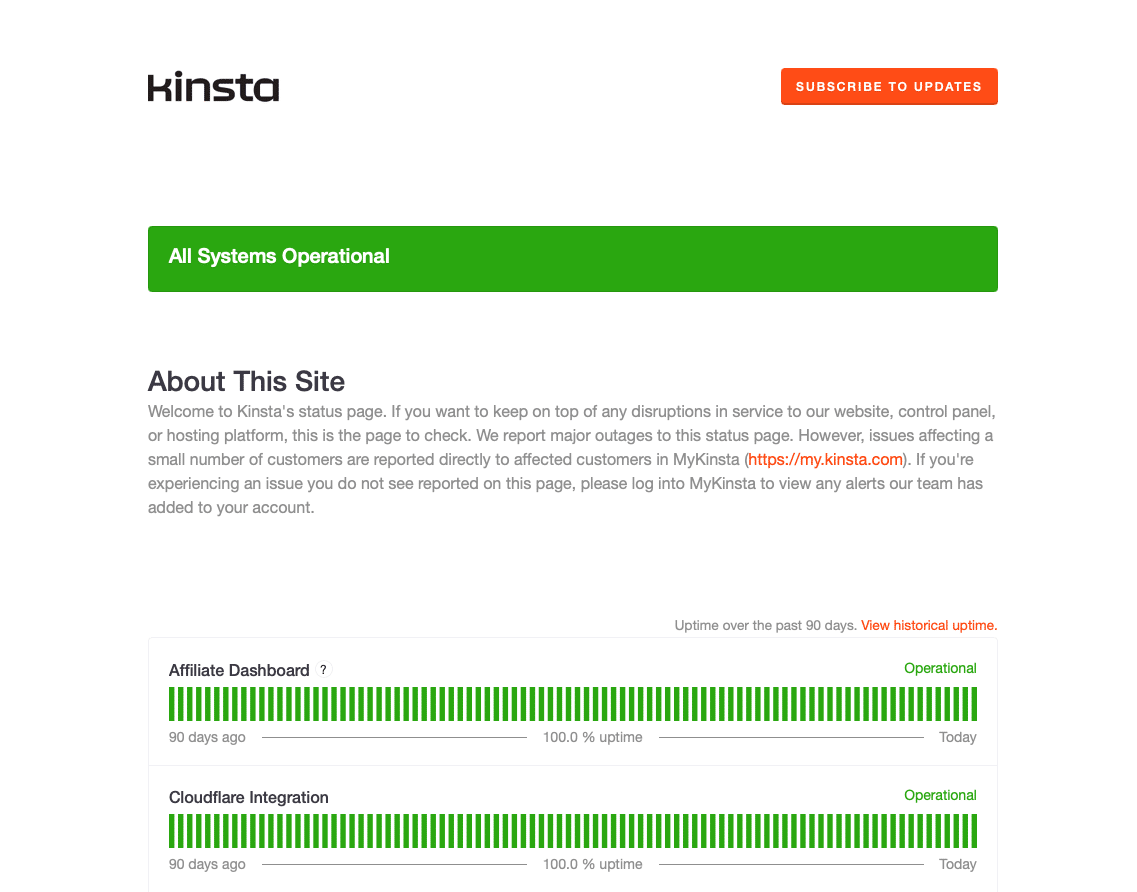
Transparency during incidents is another important factor. Providers with public status pages, clear communication updates, and post-incident summaries make it easier for agencies to keep clients informed.
Kinsta has a dedicated status page for reporting uptime and outage incidents, too:
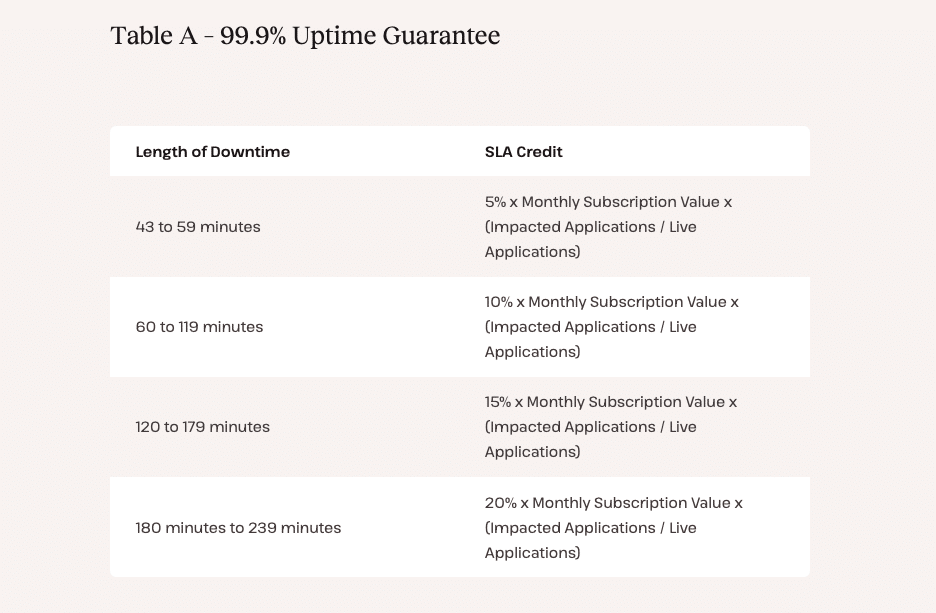
Finally, it’s worth reviewing how compensation works when uptime targets aren’t met. Many SLAs offer service credits tied to downtime thresholds, but the value and eligibility criteria can differ widely. Agencies should look at how downtime is calculated, whether claims are automatic or manual, and whether credits meaningfully offset the operational impact.
Even when compensation is modest, the presence of clear remedies signals accountability. For instance, Kinsta offers SLA credits based on the length of downtime, should it occur:
Performance guarantees and infrastructure reliability
Some hosting SLAs go a step further than uptime by addressing performance expectations. Instead of focusing only on availability, they may reference response times, resource allocation, or consistency under load.
For agencies running marketing campaigns or e-commerce sites, that distinction matters. A site can be technically online yet still slow enough to affect user experience and results.
When evaluating performance-related guarantees, it helps to look at the infrastructure behind them. Key factors that support reliable performance often include:
- Isolated environments: Prevent neighboring sites from consuming shared resources and impacting speed or stability.
- Scaling capabilities: Allow resources to accommodate traffic spikes without downtime.
- Global data center coverage: Reduce latency by serving visitors closer to their geographic location.
- Built-in caching and CDN integration: Improve delivery speed and reduce server load during high-demand periods.
- Modern hardware and network redundancy: Support consistent response times and reduce issues.
These elements shape how well a site performs during real-world conditions, especially when traffic is unpredictable or campaign-driven.
For agencies, performance reliability ties directly to measurable outcomes. Slow response times can affect search visibility, increase bounce rates, and limit conversion potential. During paid campaigns or product launches, performance inconsistencies can also reduce return on ad spend and create avoidable client concerns.
Performance guarantees don’t eliminate variability entirely, but they signal that a hosting provider is willing to define and stand behind certain expectations. Combined with strong infrastructure, those commitments help agencies deliver more consistent experiences and reduce surprises during high-stakes moments.
Support SLAs: Response time vs resolution time
Support guarantees often look straightforward on paper, but the details behind them make a big difference for agencies. Most SLAs break support commitments into a few key metrics, each describing a different stage of the support experience.
Common terms you see include:
- First response time: How quickly a provider acknowledges a ticket or live chat request
- Resolution time: The average or target timeframe for fully addressing the issue
- Escalation paths: Defined processes for routing complex or urgent issues to senior engineers
- Availability hours: Whether support is limited to business hours or offered around the clock
Understanding those distinctions helps agencies set realistic expectations during time-sensitive situations. A fast first response is reassuring, but it doesn’t necessarily mean the issue gets resolved quickly. Resolution timelines and escalation processes often carry more weight.
Agencies value strong support SLAs during launches, migrations, and unexpected incidents. Access to knowledgeable support at any hour can shorten troubleshooting cycles and prevent small issues from turning into client-facing disruptions.
Some hosts also combine support SLAs with proactive monitoring and intervention. When providers detect issues early or resolve them before a ticket is submitted, agencies spend less time troubleshooting and more time focusing on client work.
Security guarantees and incident response commitments
Security responsibilities are another area where SLAs can provide much-needed clarity. While every hosting provider talks about security, documented guarantees outline what’s actively managed, what’s monitored, and how incidents are handled when they occur.
Security-related commitments in hosting SLAs often include:
- Malware detection and removal: Clear processes for identifying infections and restoring affected environments.
- DDoS protection: Network-level safeguards designed to mitigate traffic-based attacks before they impact site availability.
- Patch and infrastructure updates: Defined responsibilities around maintaining server software, operating systems, and platform components.
- Firewall and monitoring coverage: Ongoing traffic inspection and threat detection at the infrastructure level.
Beyond preventive measures, incident-response expectations play a major role in how agencies experience security events. Strong SLAs typically address detection timelines, communication practices, and the level of remediation support provided. Agencies benefit from knowing how quickly suspicious activity is investigated, how updates are shared during an incident, and whether hands-on assistance is included in the recovery process.
These guarantees carry extra weight for agencies working with regulated industries or enterprise clients. Compliance requirements, data protection expectations, and reputational risk all increase the stakes when security incidents occur. Having documented responsibilities and response processes makes it easier to demonstrate due diligence and maintain client confidence.
Backup, recovery, and disaster recovery assurances
Backups are often mentioned in hosting plans, but SLAs help clarify how dependable those safeguards really are. Details such as backup frequency, retention windows, and restore processes determine how quickly agencies can recover from data loss, site errors, or security incidents.
When reviewing backup-related guarantees, agencies should pay attention to a few core elements:
- Backup frequency: Whether snapshots run daily, hourly, or in real time.
- Retention policies: How long backups are stored and how many restore points are available.
- Restore guarantees: Expected timeframes for completing a restore and whether support assistance is included.
- Offsite storage or geographic redundancy: Additional protection against localized infrastructure failures.
Beyond backups themselves, many SLAs reference recovery time objectives (RTO) and recovery point objectives (RPO). RTO reflects how quickly a site can be restored after an incident, while RPO indicates how much data loss is acceptable based on the most recent backup. Together, these benchmarks help agencies align hosting safeguards with client expectations and tolerance for disruption.
Viewed through a broader lens, backup and disaster recovery guarantee support for business continuity planning. Agencies managing critical sites need confidence that infrastructure failures, security incidents, or accidental changes won’t lead to prolonged disruption.
SLA transparency and reporting: What agencies should expect
Clear reporting is what turns SLA promises into something agencies can actually verify. Access to real-time monitoring dashboards, public status pages, and historical uptime data gives teams visibility into how a hosting environment is performing day to day, not just when an incident occurs.
That transparency makes client communication much easier. When performance dips or outages happen, agencies can reference provider updates, share accurate timelines, and avoid speculation. It also helps reinforce hosting recommendations, as documented performance data provides a concrete basis for explaining why a particular platform was chosen.
Reporting capabilities can also support internal reviews and compliance needs. Historical logs, incident summaries, and performance metrics make it easier to evaluate trends, prepare for audits, and conduct post-incident analysis. Over time, that visibility helps agencies refine their infrastructure decisions and respond to disruptions with more confidence.
Hidden limitations and exclusions agencies should watch for
SLA guarantees often look strong at a glance, but the fine print can introduce limitations that affect how those commitments apply in practice. Scheduled maintenance windows are a common example. Providers may exclude planned updates from uptime calculations, which is reasonable, but the timing and frequency of those windows can still influence client experience.
Other exclusions may include third-party integrations, custom configurations, or issues arising from application-level changes. If a slowdown or outage stems from a plugin conflict, external service, or misconfiguration, the provider may not consider it a breach of their SLA. That distinction can leave agencies navigating gray areas during troubleshooting or client conversations.
Definitions also matter. Some SLAs describe downtime narrowly, focusing on complete service unavailability while excluding partial performance degradation or regional disruptions. In those cases, a site might be slow or intermittently accessible without technically violating the uptime guarantee.
Because of these nuances, it’s worth reviewing SLA language carefully and asking questions before committing. Clarifying how downtime is measured, what scenarios are excluded, and how edge cases are handled helps agencies avoid surprises and ensures the agreement aligns with real-world expectations.
Questions agencies should ask when evaluating hosting partners
SLA documentation can be dense, so having a set of practical questions makes it easier to spot gaps and compare providers on equal footing. These conversations also help clarify how guarantees translate into day-to-day operations rather than staying theoretical.
When reviewing a hosting partner’s SLA, agencies may want to ask:
- How is uptime measured and reported? Clarify whether availability is tracked at the infrastructure, network, or application level and whether historical data is accessible.
- What happens when support requests need escalation? Understand response timelines, escalation paths, and whether senior engineers are available during complex incidents.
- What security responsibilities are covered by the provider? Confirm coverage around monitoring, patching, incident response, and hands-on remediation support.
- How frequently are backups created, and how quickly can restores be completed? Check if backup policies match client expectations around data loss tolerance and recovery timelines.
- What compensation applies if SLA targets aren’t met? Review how service credits are calculated, whether claims are automatic, and whether remedies feel proportionate to the impact.
- Which scenarios are excluded from guarantees? Identify limitations tied to maintenance windows, third-party services, or configuration-related issues.
Asking these questions also makes it easier to compare hosting guarantees against your own agency commitments. If your retainers promise rapid response, strong uptime, or proactive monitoring, your hosting SLA should reinforce those expectations rather than create gaps you need to manage later.
How managed hosting strengthens SLA reliability
SLA commitments carry more weight when they’re backed by proactive operations. Managed hosting providers typically invest in continuous monitoring, platform-level optimization, and specialized support teams that can detect and address issues before they escalate. That oversight reduces the likelihood of outages, performance instability, and security gaps in the first place.
For agencies, this translates into fewer reactive tasks and more predictable site management. When the hosting partner handles infrastructure maintenance, security patching, performance tuning, and monitoring, teams can focus more on client strategy and delivery instead of troubleshooting server-level concerns.
Providers like Kinsta illustrate this connection by pairing documented guarantees with managed environments, performance-focused architecture, and experienced support teams. That alignment helps agencies rely on SLA commitments with greater confidence.
Think of SLAs as a partnership agreement with your agency
SLAs help define how accountability and communication work between agencies and their hosting providers. Clear guarantees create transparency around performance, support, and recovery expectations, which makes it easier to navigate incidents without uncertainty or finger-pointing.
For agencies, that clarity supports more than the technical side of things. It strengthens client confidence, reinforces service promises, and reduces risk as your portfolio grows. Reviewing SLAs carefully and ensuring they align with your commitments ensures your hosting stack supports the experience you want clients to have.
If you’re evaluating partners with those priorities in mind, managed platforms like Kinsta offer documented guarantees backed by proactive infrastructure and expert support. Feel free to talk to sales if you wish to understand these further.